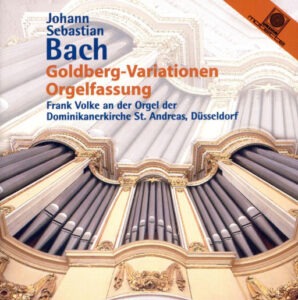
Album Details
Johann Sebastian Bach – Goldberg-Variationen Orgelfassung
Frank Volke
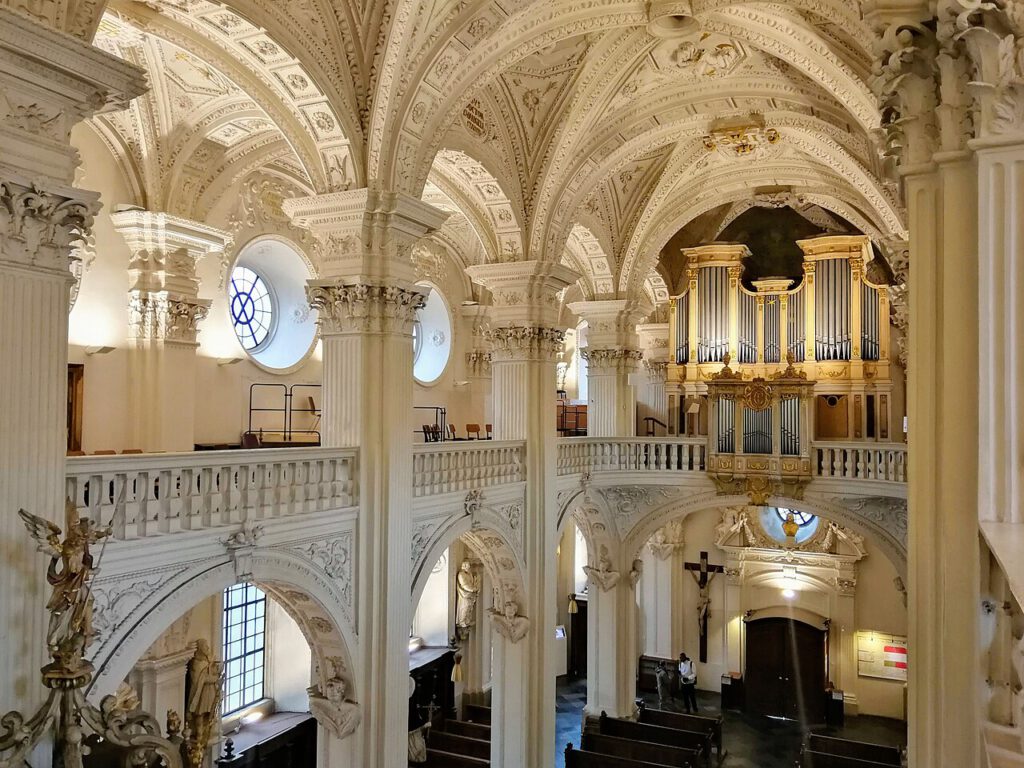
Dominikanerkirche St Andreas, Düsseldorf, Germany
Motette Psallite Verlag (recorded 1998)
Album Contents
Goldberg-Variationen, BWV 988 ❤
Bach’s Goldberg Variations have become a fascination for me, and this was the first recording that came into my collection, as far as I can remember my first exposure to this glorious music too. Oddly though, this disc wasn’t what started the fascination – for many years it sat in my collection as a warmly appreciated but hardly ground-breaking album. It was fifteen years or so later that I acquired a second Goldberg, and it was this that got me thinking about the art of ‘transcribing’ or ‘arranging’ this work for organ.
This album by Frank Volke is not the first (Jean Guillou in 1987 is the earliest I’ve found, with recordings by Käte van Tricht and Bernard Lagacé released in the following decade) but I think it’s fair to consider it one of the pioneers…since then, more than 25 additional recordings have been made, perhaps showing that the fascination of this aria with variations adapted to the organ isn’t just mine!
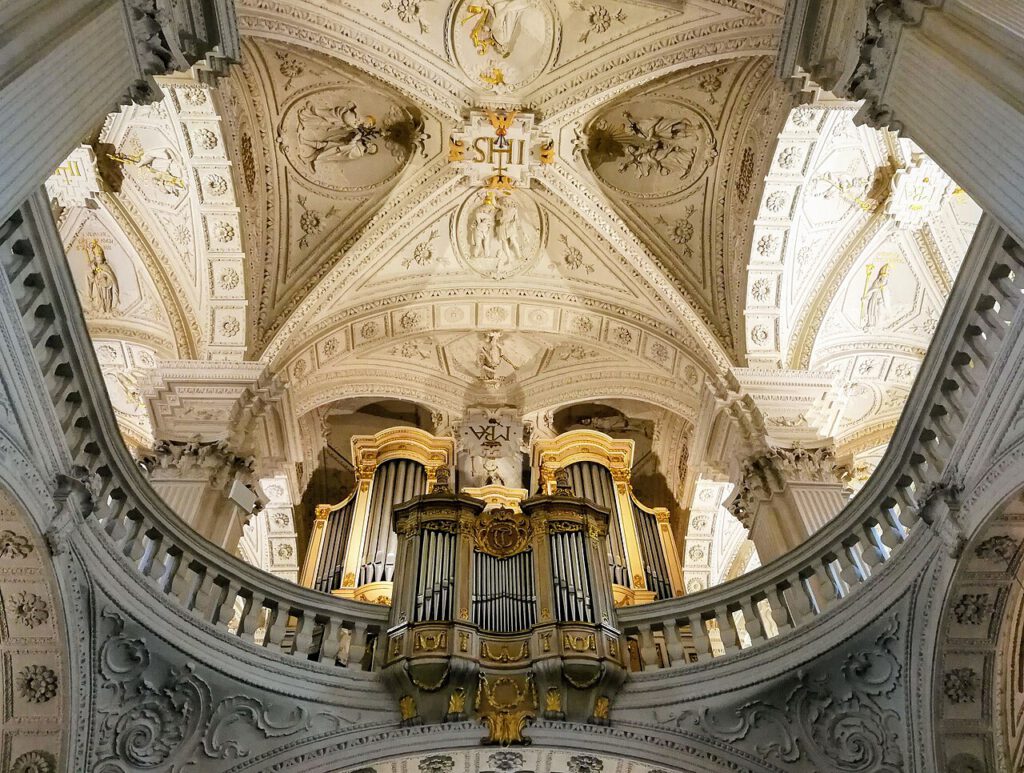
Image courtesy of Subbass1, CC BY-SA 4.0, via Wikimedia Commons.
Already in these first two paragraphs the consideration of whether the Goldbergs on the organ is a transcription, arrangement or adaptation has appeared. Bach’s original title was ‘Keyboard Practice, consisting of an Aria with divers Variations for the Harpsichord with two manuals.’ The epithet ‘Goldberg’ only appeared in Forkel’s 1802 biography, long after Bach’s death. It is clear then that this was intended for a harpsichord, the only other instrument that could offer more than one keyboard – a capability Bach used to allow for crossing hands and a degree of tonal differentiation within and between variations. The organ takes this capability further, with a much richer tonal palette…and possibly more keyboards too, but this wouldn’t be obviously exploited through Bach’s original score.
Of itself, a performance on the organ could be just that…a straightforward performance moved from harpsichord to organ. But the question of pedals needs to be addressed, and how to register on an instrument with so much more variation in tone and pitch than the harpsichord. This is where performance moves into the world of transcription or arrangement. The most radical approach is certainly Wilhelm Middelschulte organ arrangement published in 1926 – it is Bach, updated to fully use the rich resources of late-romantic instruments, making use of deep pedal flues and adding new contrapuntal voices as needed. In contrast, Volke’s approach is as simple and clean as the Beckerath organ upon which he plays.
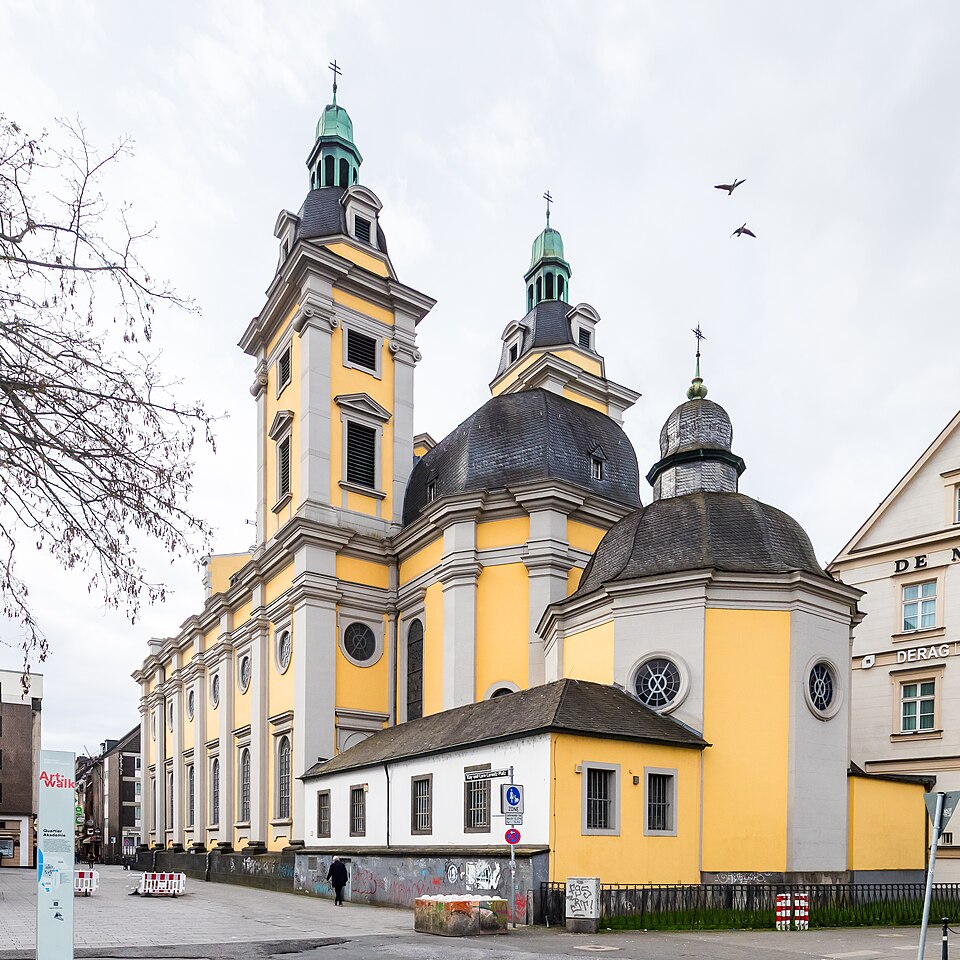
Image © Raimond Spekking, CC BY-SA 4.0, via Wikimedia Commons.
Built in 1971 by Beckerath, the three-manual 42-stop instrument in Düsseldorf’s St Andreaskirche (the priory church of the local community of Dominican friars) sits within the surviving case of the 1782 instrument by Peter Kemper. Six prepared-for stops were completed in 1973, and since then two overhauls in 2003 and 2025 by Beckerath have kept the instrument in perfect working order. There have been no modifications to the pipework, but in 2025 electrically operated sub-octave couplers were added, together with an updated piston-capture system.
The firm’s founder, Rudolf von Beckerath, came out of the organ-reform tradition; he was inspired by north-German instruments by the likes of Arp Schnitger, and trained with Victor Gonzalez in France, and was a voicer at Frobenius. He championed mechanical key action, clearly appreciating its immediacy and sensitivity of touch. Landmark instruments by Beckerath are found in the Oratoire St Joseph, Montréal, Canada (1960), St Paul’s Cathedral, Pittsburgh, USA (1962), St Andreaskirche, Hildesheim, Germany (1966), and the University of Sydney, Australia (1972). The firm was truly international, and the Düsseldorf instrument sits right within this period of great creativity.
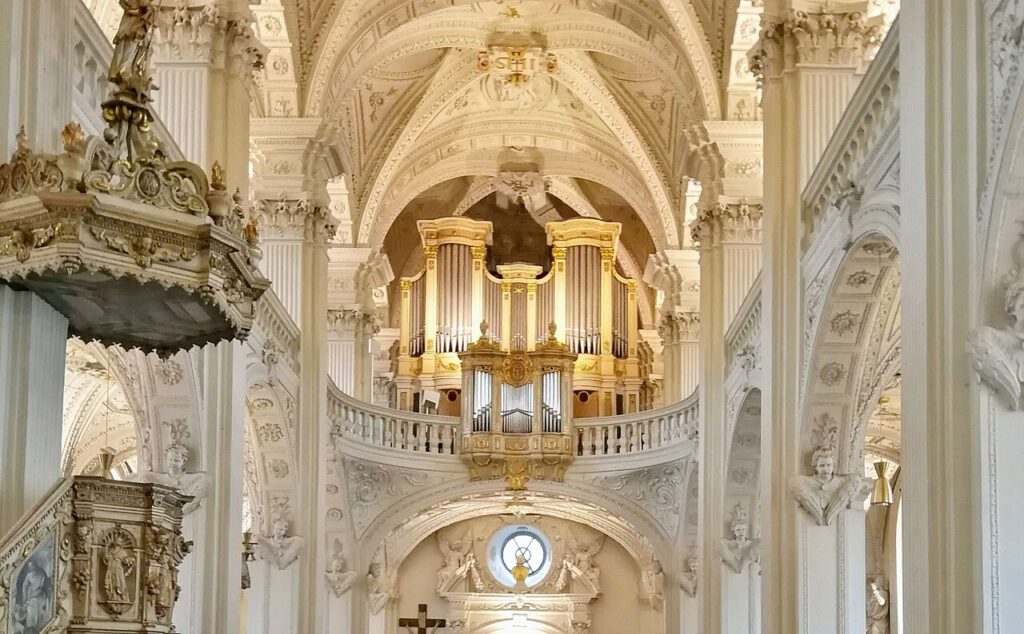
Image courtesy of Subbass1, CC BY-SA 4.0, via Wikimedia Commons.
All these instruments are wonderful products of the mid-20th-century Organ Reform movement, looking back to the past for inspiration (sound purity, defined choruses, independent tiered manual departments) but yet to embrace slavishly historic reconstructions, the likes of which we hear (and enjoy) today. The organ in Düsseldorf is quite emphatically a modern twentieth-century instrument, inspired by the past. It’s a sound world I adore, and the Goldberg variations give ample opportunity to explore. Overall, we hear Bach refracted through a mid-twentieth century’s attempt to rediscover what the organ itself had once been.
As I’ve been writing the above, I’ve wondered what I actually say about the performance itself. Volke’s playing is beautifully crisp and precise, at times feeling almost muscular with its firm motoric drive. These adjectives could be used equally well to describe the instrument itself, so I’ve had to spend time to see if I can separate the two! I’m not sure I’ve really succeeded, and perhaps that’s no bad thing – performer and organ are perfectly aligned. Volke spent more than 20 years as organist at St Andreas, so this is an organ he knew intimately when embarking on this recording.
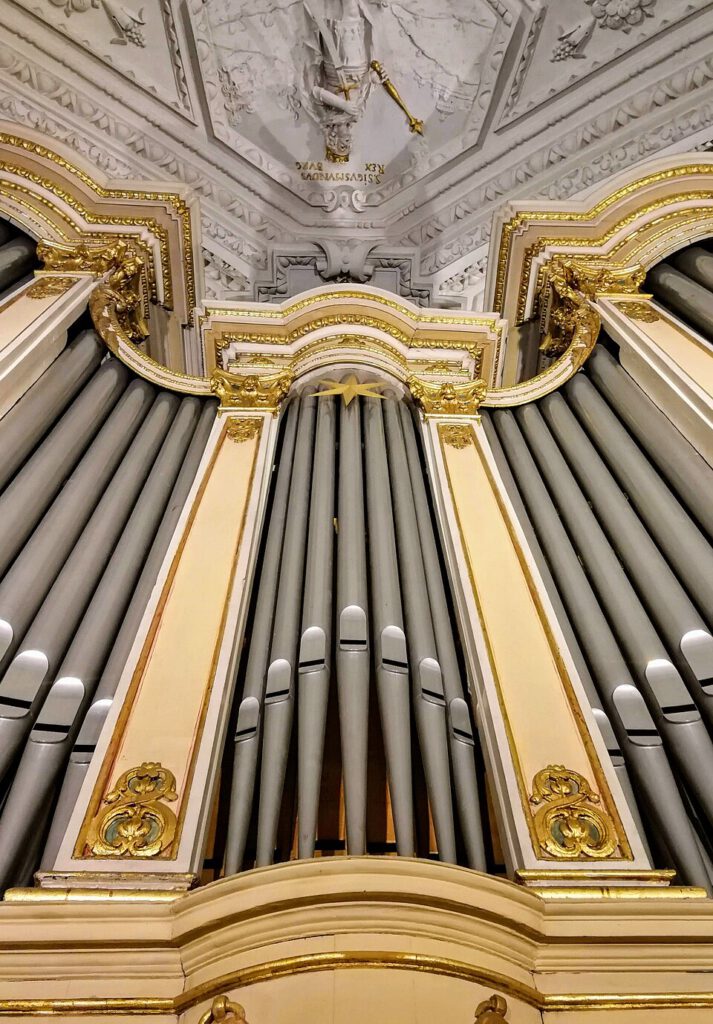
Image courtesy of Subbass1, CC BY-SA 4.0, via Wikimedia Commons.
The opening aria, which is often delicately laid out has a firm, no-nonsense approach to it under Volke’s fingers. The Beckerath principals and flutes have a solidity that isn’t always found on organs of this date; and they are underpinned by warm pedal flues. Volke is both organist and pianist, but he is clearly approaching this performance as an organist, making full use of the opportunities afforded by multiple keyboards, registrational colour and pedals.
Through the ensuing variations the many different tonal facets of the organ are displayed. Delicate ensembles delicately capped by bright 2′ superoctaves, limpid flutes with crisp intonation, scintillating mixture work above rich pedal reeds, a colourful Ruckpositiv Cromorne in dialogue with flue choruses, perfectly voiced 4′ flutes dancing up and down the compass. I could keep going…but suffice it to say this organ is almost perfectly balanced, a true testament to Beckerath. That mixture work is indeed scintillating but it’s not harsh or unruly; rather it’s beautifully controlled. I almost used “bucolic” to describe that Cromorne, but it isn’t – it has just enough rasp to add character, but it is kept in check and maintains a uniform character from note to note. This organ sounds almost too good to be true; perhaps a few imperfections would give it some welcomed personality, but it is still a lovely instrument to listen to…and I imagine the player also has the same experience of control and balance at the keys. Certainly Volke’s performance has the feeling of calm poise throughout.
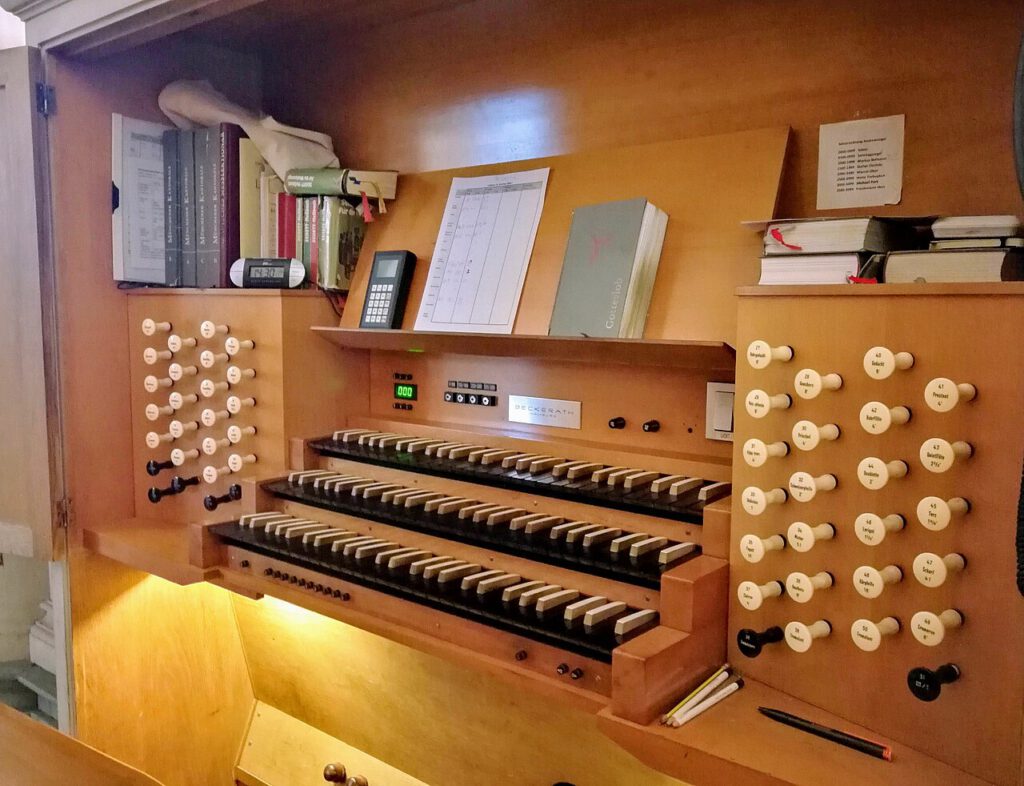
Image courtesy of Subbass1, CC BY-SA 4.0, via Wikimedia Commons.
The performance ends as it begins – Volke uses an identical registration for the closing Aria da capo e fine as he does at the beginning, but now omitting the repeats which were included for the opening Aria. These two arias, start and finish, are indistinguishable bar the inclusion or omission of repeats – if the repeats were consistent, I would seriously consider whether it was the same rendition re-used by the editor. This matter-of-fact ending says nothing to the fact that we’ve reached the end of an hour’s musical journey. Some performers (but by no means all) do offer that sense of arrival, through subtly varied registration, tempo and/or ornamentation, which I like. Perhaps, though, this is a circular journey, and we end up where we began (mon fin est mon commencement, in the immortal words of Machaut).
Regardless of whether we’ve reached the end or are back at the start, the journey has been a positive one. This is a clean, polished performance, showcasing a wonderful example of refined 1970s organ building that well serves Bach’s creativity.