Album Details
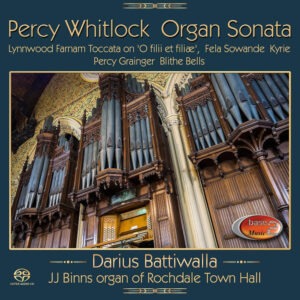
Percy Whitlock Organ Sonata
Darius Battiwalla
The Great Hall, Rochdale Town Hall, UK
Base2 Music (recorded 2020)
Album Contents
Toccata on ‘O filii et filiæ’ — Lynnwood Farnam
Sonata in C minor — Percy Whitlock
Kyrie — Fela Sowande
Blithe Bells — Percy Grainger
I well remember hearing my first recording of the Binns organ in Rochdale Town Hall, which must have been some thirty-five years ago – Priory Records’ Great European Organs No.20, with Jonathan Bielby playing the complete works of John Ireland, plus other late romantic English music. At that time, I certainly enjoyed it, but neither organ nor music really excited me. It is only more recently that I’ve realised just how fine an instrument this is, aided by an acoustic which is far removed from the dryness of a typical town hall or concert hall. This 2020 recording by Base2 Music brings us closer to the present day, with an exquisite audio capture of a richly specified instrument that continues in excellent health following restorations in 1978 and 2003. Leeds City Organist Darius Battiwalla puts the Binns through its paces with a programme which allows full exploration of its considerable tonal resources – Whitlock’s substantial Sonata lies at the heart of this, with music either side by Farnam, Sowande and Grainger for contrast and added interest.
Public domain image, via Wikimedia Commons.
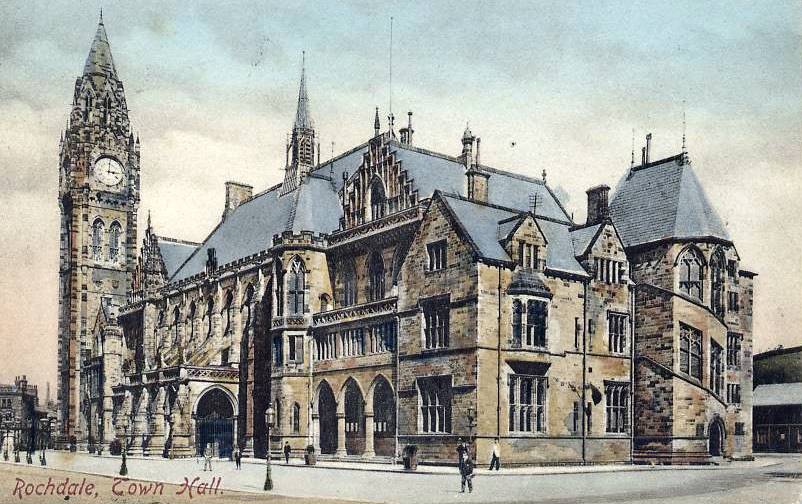
The Grade-I listed Rochdale Town Hall was opened in 1871, an extravagant Victorian Gothic-revival creation acting as a symbol of the town’s importance in the textile trade. It seems there was provision for an organ in the Great Hall from its inception, with a chamber provided behind three large arches at one end of the hall, but it wasn’t until 1913 that an organ donated by Sir Samuel Turner JP, an Alderman of the Rochdale Corporation (now Rochdale Borough Council), was installed. It was opened with a recital by Herbert Walton, organist of Glasgow Cathedral, on 10th July 1913, with Their Majesties King George V and Queen Mary in attendance. The contract for this four-manual 53-stop instrument was placed with the firm of James J. Binns of the Bramley Organ Works in Leeds. Sir Samuel would have been familiar with Binns work from the 1892 three-manual 39-stop organ at his regular place of worship, Rochdale’s Baillie Street Methodist Church – sadly this church was closed and demolished in the late 1960s, but the organ lives on (albeit with rather intrusive tinkering to its specification) through a transplant to Christ Church, Worthing.
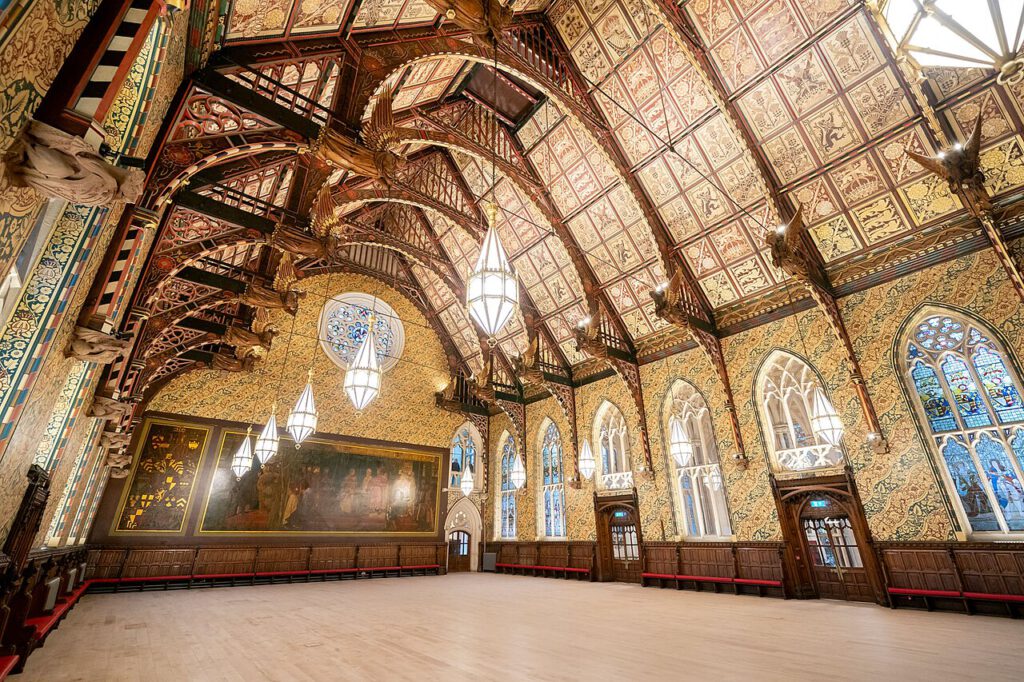
Image courtesy of Michael David Beckwith, CC0, via Wikimedia Commons.
Despite their solid engineering and brilliant Schulze-inspired voicing, there are remarkably few large organs by ‘Battleship Binns’ in existence. A near-identical 1909 twin to Rochdale sits in Nottingham’s Albert Hall (four manuals and 59 stops), but rich as the latter organ’s specification is, and as sturdy the overall tonal effect, to my ears it lacks the grace that Rochdale’s resplendent acoustic wraps around the Great Hall’s pipework. A comparison can’t be made with this recording, but I don’t think anyone will fail to be impressed by the quality of the Rochdale instrument after listening to this recital by Battiwalla.
As to the recorded sound…well, suffice it to say that this is simply stunning
The opening seconds of Lynwood Farnam’s exciting (but brief) Toccata on ‘O filii et filiæ’ set the scene – a hefty chord with the firm warmth of big pedal flues dissolves into cascading arpeggios, Binns’ bright mixture work having just sufficient metallic edge to cut through the Easter hymn ‘O sons and daughters, The King of Glory, King adored’ heard in the pedals. The melody is then heard at the very bottom and top of large chords, before the whirling cascades commence again. Almost as soon as you’ve realised the ‘plan’ of alternating toccata and grand harmonisation, it draws to a somewhat perfunctory close. Beyond the delight of the organ in this opening work, the energy and precision of Darius Battiwalla’s performance is immediately obvious, and as to the recorded sound…well, suffice it to say that this is simply stunning.
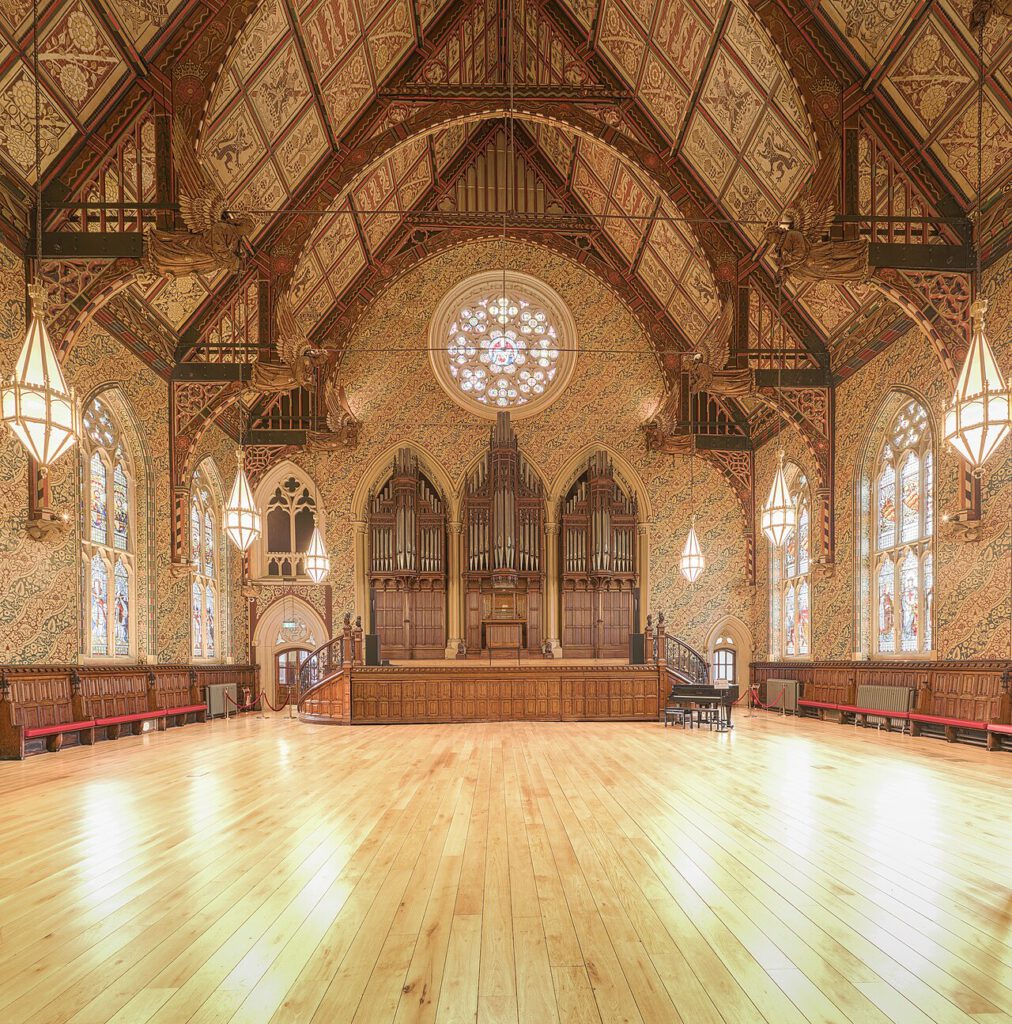
Image courtesy of Entropyjazz, CC0, via Wikimedia Commons.
Base2 Music’s owner and recording engineer, Jake Purches, is on a mission to capture exhilarating performances with sonic mastery using the very best technology available. The label offers high resolution audio in both surround sound and stereo (I was listening to the stereo version), in tangible physical forms and lossless download formats. On the evidence of this recording (the first I’ve listened to from Base2 Music) he certainly has some secrets up his sleeve to produce such a vibrant, pristine-sounding recording where the full range of the organ is truly heard. You genuinely experience the all-enveloping warm profundity of the Pedal 32′ flue, whilst the upper work remains crystal clear; the quietest strings are nicely present, and the full organ is gloriously imposing without any sonic obliteration. How much of this can really be credited to Purches rather than Binns I don’t know, but there is no doubt that this is a spectacular recording of an organ treasure.
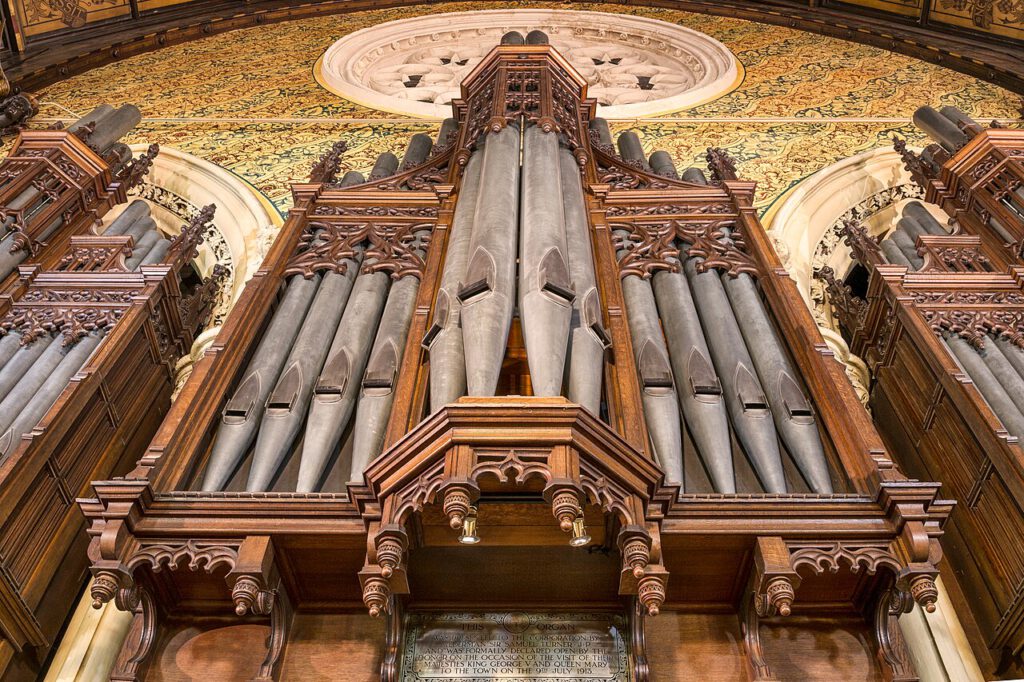
Image courtesy of RevDave, CC BY-SA 4.0, via Wikimedia Commons.
Whitlock’s large-scale Sonata in C minor follows. As the liner notes comment, it’s hard to believe that such a substantial and so finely wrought work should end up completely forgotten within 30 years of Whitlock’s early death in 1946. It took Graham Barber to re-introduce it to the world in 1978 with a performance from Coventry Cathedral, captured on vinyl by Vista Recordings. Michael Smythe, Vista’s owner and producer, commented on the original LP sleeve: ‘It is rarely that a piece of music has moved me as much as the Whitlock Sonata. Although, on being introduced to the work by Graham [Barber] and [producer] Geoffrey [de Coup-Crank], I was at first only moderately impressed by sections of it. Now, however, I listen to it whenever I can, and it has become one of my favourites of the organ repertoire’. My own experience with this music is much the same – on initial hearing it was clearly very fine music, but only after repeated listening and seeking out other interpretations did I get hooked. Today, as for Smythe, it is one of my favourites. I have numerous recordings on many of the finest, most perfectly suited instruments – now this recording by Darius Battiwalla gets added to that pantheon.
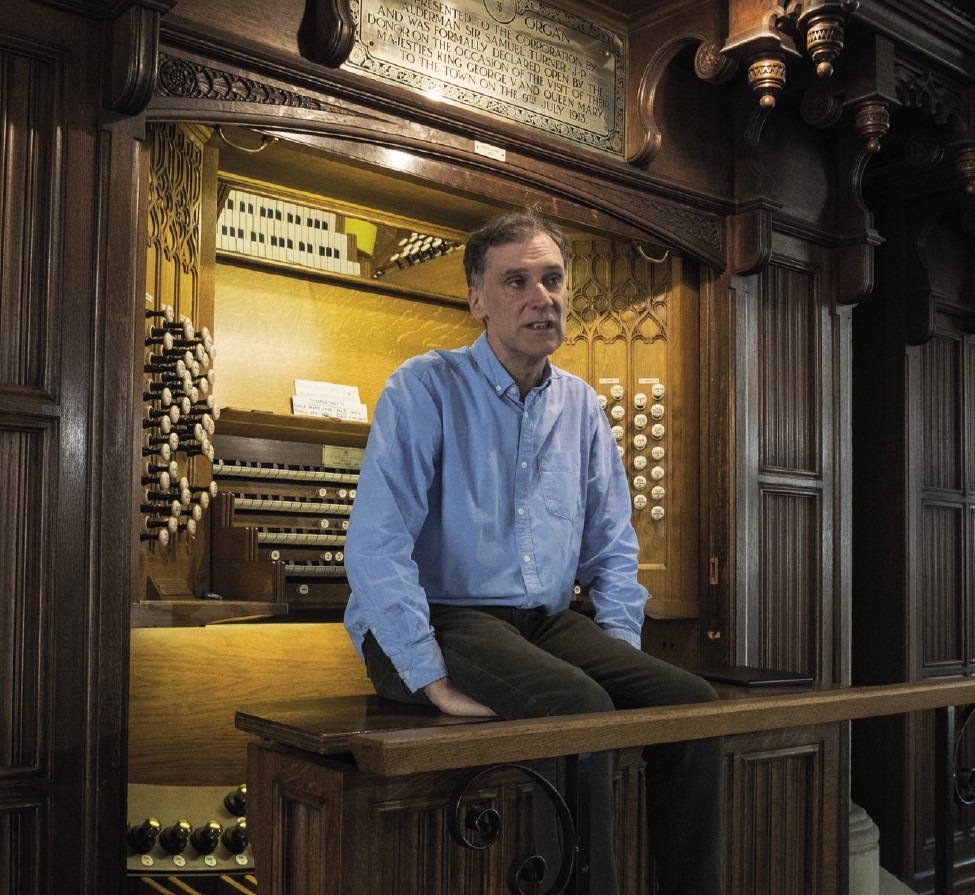
Image © Jake Purches (Base2 Music) and used with permission.
Battiwalla affords it all the grandeur, delicacy and humour that it demands throughout its 45-minute duration, this variety reflecting Whitlock’s eclectic musical spirit in both church circles and light entertainment. He spent several years as assistant organist at Rochester Cathedral, having sung there are as a chorister when a boy. Though widely tipped to succeed his mentor Charles Hylton Stewart upon his appointment to Chester Cathedral, Whitlock was ultimately bypassed for the principal organist role – this slight resulted in his move from Kent to Bournemouth in 1930. Here he first worked at St Stephen’s Church, and then in 1932 was appointed as Borough Organist, master of a large Compton organ in Bournemouth Pavilion. He split his time between these two contrasting roles for a few years, but in1935 he relinquished the church post to focus on the Pavilion. It was in the ensuing years that the Sonata was composed; published in 1937, Whitlock gave the first performance on 28th January 1938 at his former church of St Stephen, Bournemouth, home to a 1915 three-manual, 40-stop Hill organ (which has had minor revisions and a few additional stops since Whitlock’s time).
The Sonata is Whitlock’s most ambitious score for solo organ, matched only in scale by the Symphony in G minor for Organ and Orchestra. The massive outer movements (a dramatic opening Grave – Allegro and epic final Choral) sandwich two lighter movements (a song-like Canzona and filigree Scherzetto with delicately complex cross rhythms). There are clear inspirations by Rachmaninov, Delius and Elgar, the first two specifically referred to in a Greek cryptogram that Whitlock added to the head of the score – decoded, it reads ‘On hearing the Second Rachmaninov in Spring.’ The impassioned opening movement, in sonata form, starts with a reedy three-chord motif which reappears several times through the work; the main subject which follows is a turbulent affair, ideal to explore rich foundations with Swell reeds bursting forth as required. The second subject is more delicate, offering a soothing lyrical contrast to the first subject’s angst. Whitlock’s quarter-of-an-hour exploration of these themes makes use of the organ’s full resources, including solo orchestral reeds and brassy tuba fanfares – the whole benefits from a taut ebb and flow that keeps up the tension throughout. The Canzona and Scherzetto are classic Whitlock miniatures, finely crafted character pieces which nonetheless feel a little out of place after the might of what’s come before, and the even great heft of what’s to follow.
The concluding Choral is a 20-minute symphonic outpouring based around a modal chorale theme which forms the core of an expansive set of variations. Through the work, we hear moments of English pomp and ceremony, introspective solo voices, a colourful scherzo dancing between two manuals, and, harking back to the very first notes heard in the opening movement, fanfare-like chordal motifs (with plenty of outings for the Binns unenclosed Tuba). The apotheosis is a grand harmonisation of the chorale (Rachmaninov would surely have approved); fortissimo chords underpinned by the deepest pedal notes mark the climax…but not the end. Perhaps surprisingly, the energy suddenly fades, and a contrasting coda draws the work to a calm C-major conclusion, in which fragments of the chorale are heard, this time pianissimo.
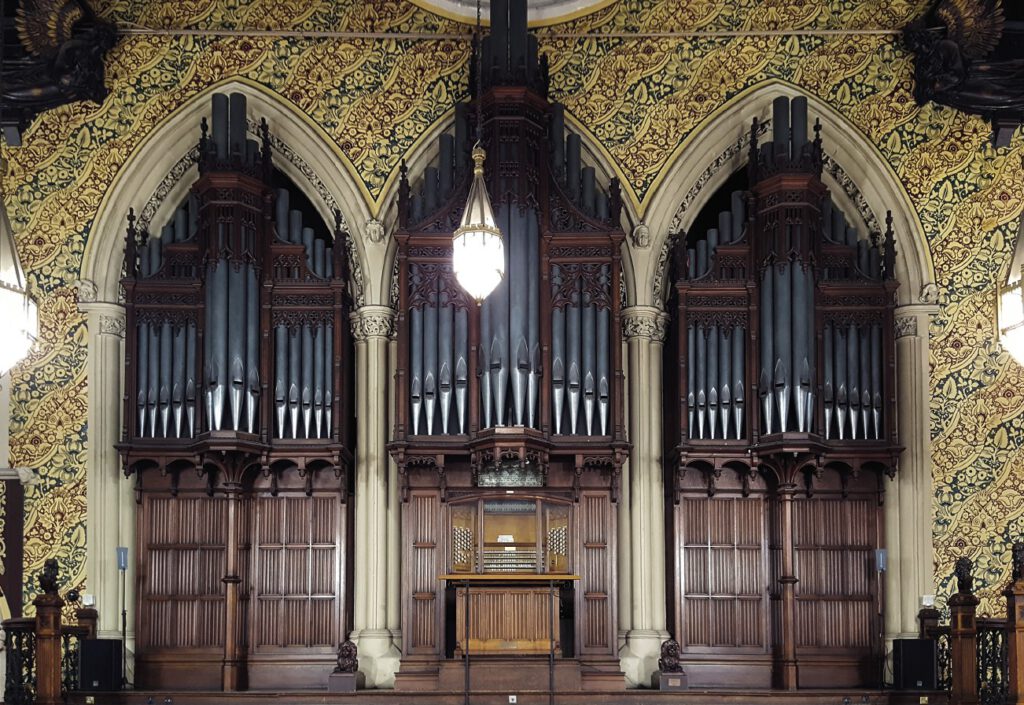
Image © Jake Purches (Base2 Music) and used with permission.
Battiwalla and the Binns organ deliver everything that’s needed for this towering masterpiece. The diapasons are smooth but alive; the Tuba has the heft to stand out over the rest of the organ but doesn’t overpower; and the strings are sufficiently keen to cut through without becoming scratchy. Battiwalla takes this palate and paints the perfect picture of quintessential, nostalgic Englishness fused with Rachmaninoff’s opulent late-Russian romanticism. I could pull out beautiful example after beautiful example in Battiwalla’s fabulous performance, but will focus here on just one that particularly struck me on first listening. In the Choral there’s a moment, like sunshine appearing from behind the clouds, when a scherzo-like dance of semiquavers jumps between Choir (Flutes 8′ 4′ 2′) and Swell (8′ 4′ Strings). After all of the soaring lyricism and fervent energy that has brought us to this point, this moment offers light respite – and Battiwalla has just the perfect spacing for this delicate dialogue of contrasting ensembles, and his selection of Binns ranks is ideal, with clear contrast between the light flutes and cutting strings. This single instance exemplifies the whole album – every moment offers musical delight, all perfectly balanced in the Base2 audio capture.
Reaching the end of the Whitlock Sonata is always accompanied by a feeling of arrival…perhaps partnered with a musical and emotional exhaustion. Darius Battiwalla doesn’t allow any recovery, moving straight onto another substantial and fascinating work. Olufela “Fela” Sowande (1905-1987), the father of modern Nigerian music, merged three distinct cultural idioms into his organ music – traditional Nigerian components, African-American spirituals and European classical traditions. Born in Nigeria, he sang as a boy in the choir of the Cathedral Church of Christ, Lagos, and took organ lessons from Ekundayo Phillips (organist at the cathedral for 48 years). In his late twenties he spent time in England, studying privately with Rubbra, Oldroyd and Cunningham, earning a BMus from the University of London and Fellowships from the Royal College of Organists and Trinity College of Music. At the same time he was a bandleader and Hammond organist, and even played duets with Fats Waller! He returned to Nigeria in 1952, but briefly travelled to the US a decade later with a Rockefeller Foundation fellowship; in 1968 he moved to America permanently with a professorship at Howard University. This short biography clearly shows that Sowande was no average musician!
Kyrie dates from his years in London, when he was organist and choirmaster at the West London Mission (WLM) of the Methodist Church, serving a diverse congregation including many families from West Africa. WLM’s base was the Kingsway Hall in Holborn, London; although built as an evangelical hall for the mission, it was soon realised that it offered an excellent “concert hall” acoustic. This, together with plenty of space for numerous orchestral musicians, made it an ideal recording venue – the London Symphony and London Philharmonic Orchestras made around 400 and 280 recordings in the hall respectively. EMI, Decca, Lyrita and RCA all used the hall extensively for their productions. In 1913 a three-manual Binns organ was inaugurated in the hall, providing a lovely link between Sowande, the Kingsway Hall and this Rochdale recording. Additions were made relatively soon after by both Hill, Norman and Beard and Spurden Rutt, including an additional manual (or two?) for Solo and Echo divisions – it would have been this expanded organ that Sowande played.
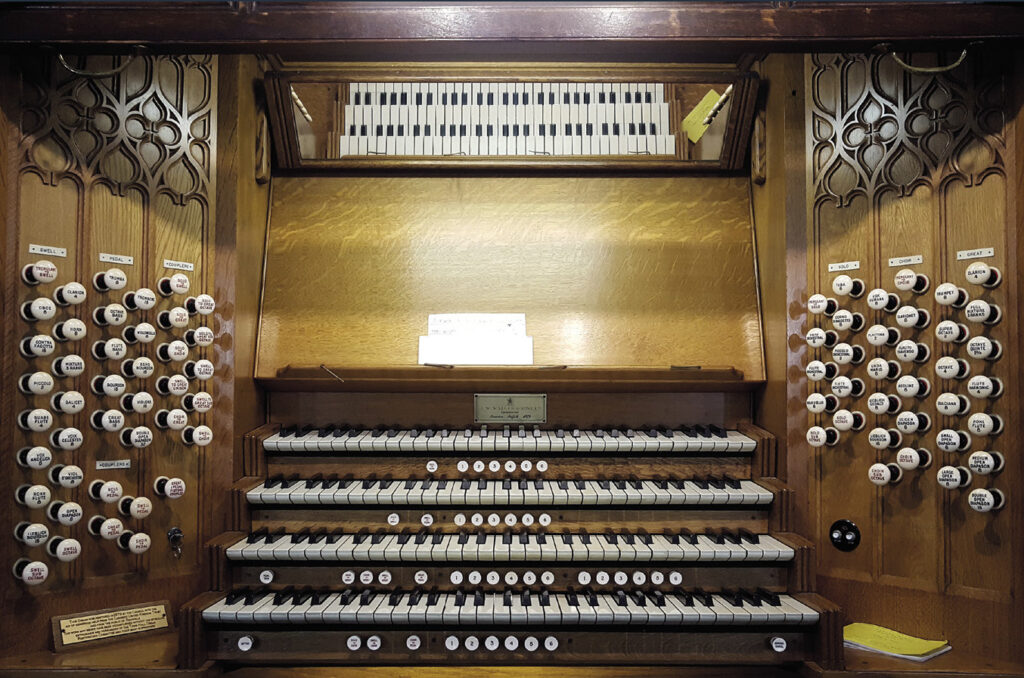
Image © Jake Purches (Base2 Music) and used with permission.
In Kyrie Sowande blends together Anglican church traditions with a Yoruba Christian melody. The melody is heard, on the Vox Humana, after a pensive introduction itself based on the Yoruba theme, gently underpinned by the 32′ Double Open Diapason. The melody is ever present, but heard only in fragments for much of Kyrie’s 13-minute duration. There are two fugal sections, the second based on a vigorously bouncing dotted motif; Sowande cuts no slack for the pedal part but it clearly doesn’t faze Battiwalla. In the last few pages the theme is heard once again in its entirety, this time fortissimo, before the work fades to a quiet end, the slow 32′ pedal figurations returning from the opening bars.
I must admit that this work is only one of two by Sowande that I have in my collection; I will certainly keep an eye out for more, because his music is well written, blending compositional rigour with emotional intensity – the blend of Nigerian, Yoruba and European styles is fascinating.
After the intellectual and musical challenges of Whitlock’s and Sowande’s large-scaled works, the album concludes with something a little lighter – Battiwalla’s own transcription of Percy Grainger’s Blithe Bells. Its full description on the score’s original title page is, rather delightfully:
“BLITHE BELLS”
A Free Ramble
by Percy Aldridge Grainger
on Johann Sebastian Bach’s aria
“Sheep may graze in safety when goodly shepherd watches o’er them”
for
15 (or more) single instruments,
or for small orchestra or massed orchestra,
or for Elastic Scoring
This is then followed by indications of ‘needful’ and ‘ad libitum‘ instruments, comments on what ‘small’ and ‘massed’ orchestral forces would be, and how to handle the ‘elastic scoring’.
The programme note included in the original score also explains that ‘the ramble is colored [sic] by the thought that Bach, in writing the melody in thirds that opens and close the number, may have at aimed at giving a hint of the sound of sheep bells.’ Grainger’s scoring calls for glockenspiel, marimba (metal and wood) and celesta to conjure up those bells – unfortunately (or perhaps fortunately!) the Rochdale organ has no percussion stops, but nonetheless Battiwalla delivers a delightfully coloured rendition which dissolves into delicate strings for the final bars.
This is a really wonderful album; fascinating music played on the superb Binns in Rochdale, a direct link back to the sound world of yesteryear. Darius Battiwalla’s artistry is obvious throughout, and his sympathetic interpretation brings the music by Farnam, Whitlock, Sowande and Grainger to vivid life. Base2 Music’s presentation is flawless – perfect sound complemented by informative liner notes rich with glimpses into Rochdale Town Hall’s musical past.