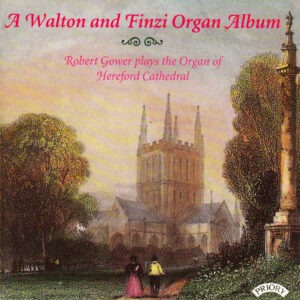
Album Details
A Walton and Finzi Organ Album
Robert Gower
Hereford Cathedral
Priory Records (recorded 2000)
Album Contents
Crown Imperial — William Walton
Intrada (from Dies Natalis) — Gerald Finzi
March; Passacaglia; Touch her soft lips and part; March (from Henry V) — William Walton
Romance — Gerald Finzi
Two Pieces for Manuals — William Walton
Prologue (from A Wartime Sketchbook) — William Walton
Five Bagatelles – 4. Forlana — Gerald Finzi
Prelude — Gerald Finzi
Five Bagatelles – 3. Carol — Gerald Finzi
Romanza (from Christopher Columbus) — William Walton
Eclogue — Gerald Finzi
Popular Song (from Façade) — William Walton
Orb and Sceptre — William Walton
I have several recordings of the Willis organ in Hereford Cathedral, and all capture it in a slightly different way, but it reliably sounds absolutely wonderful. On this disc, with Robert Gower playing through his album of Walton and Finzi arrangements published by Oxford University Press, the balance is near perfect – the pipes are sufficiently present to thrill and the spacious acoustic reminds you that this is a sizeable (but not enormous) space. The organ has a distinctive voice, which to my ears captures three key phases in its history – the Father Willis original (which of course forms the core of today’s instrument), the 1909 Willis II additions (primarily the 32′-16′ Bombarde-Ophicleide pedal reed unit) and the 1978 Harrison & Harrison (particularly the tierce-free chorus mixtures on Great and Choir). It is a relief to see that the 2004 refurbishment saw the faddish 1978 Pedal Schalmei 4′ remodelled to a more sensible Clarion.
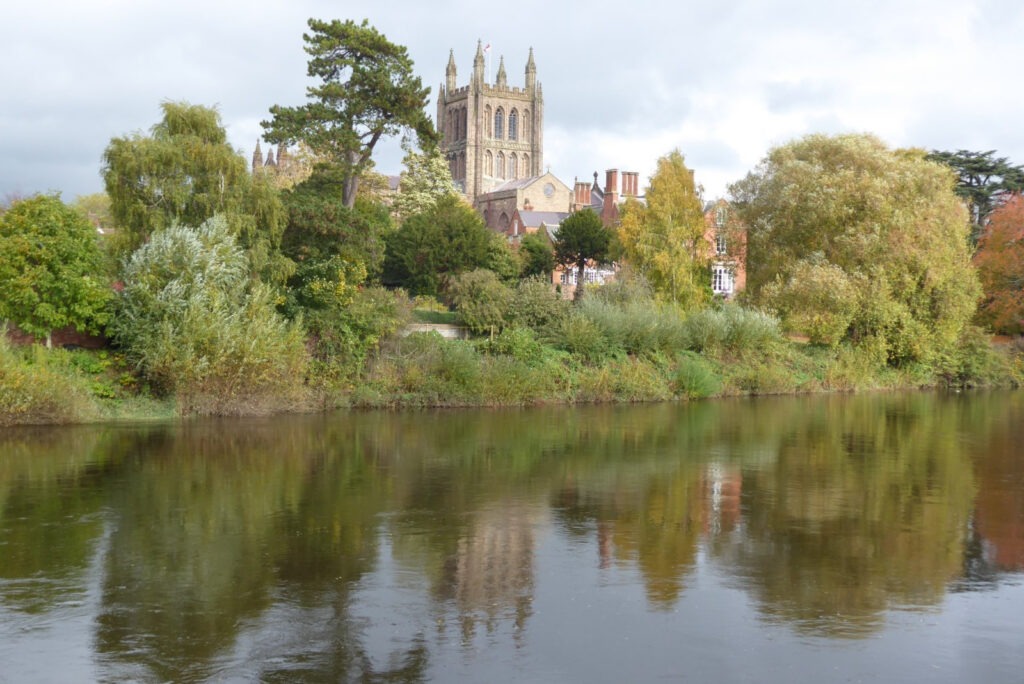
Image courtesy of Philip Halling, CC BY-SA 2.0, via Wikimedia Commons
I must admit that I find Walton a little light and frothy, and the two large works (Crown Imperial and Orb and Sceptre) are sufficiently commonplace not to draw significant attention from me on this disc. Suffice it to say that Gower plays both with aplomb – his performances are crisply driven, making the most of the ringing chorus work and particularly clangorous Tuba. Less common ‘organ’ fare from Walton (such as the Prologue from the Wartime Sketchbook, Two Preludes for Manuals, and Façade’s Popular Song) stick to a similar compositional recipe – taut rhythm, tuba fanfares and stirring English march themes. Entertaining enough, but for me it is the Finzi that steals the show.
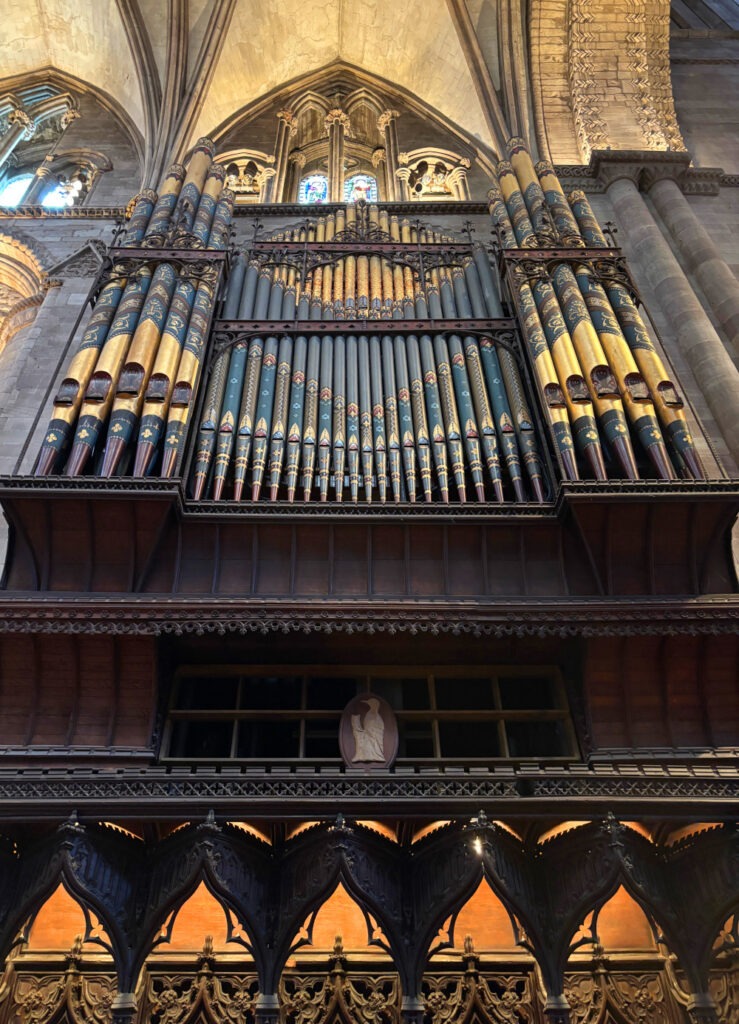
Image © Simon FitzGerald (aeolodicon.com)
In contrast to Walton’s pomp and circumstance, the Finzi works allow Gower to reveal the lush orchestral timbres of the Hereford Willis; he clearly revels in the music’s elegiac pastoralism. The seamless crescendo in the Intrada (from Dies Natalis, Op.8) is perfectly judged, as its is rapid retreat to the pianissimo conclusion. Finzi’s skills as a melodist are immediately apparent, and so too in the Op.11 Romance for string orchestra, and the two short Bagatelles (originally scored for clarinet and piano). Gower approaches each work with the same attention to detail, with beautifully fluid phrasing and a delightfully idiomatic use of the organ which is not restrained by the original orchestral scores.
The Hereford organ sounds sublime here, the perfect companion to a quite moving musical experience
The ravishing Eclogue is the highlight, offering ten minutes of dream-like melody, gently ebbing and flowing. Initially conceived by Finzi as the central movement to a never-completed piano concerto, he later revised it to a standalone work, and it was prepared for posthumous publication by friends and family, at which point it was given its name. Traditionally, an eclogue is a conversation between shepherds captured in poem – from Finzi it becomes a timeless dialogue between piano and strings, or, in Gower’s adept arrangement for organ, an exploration of quiet flutes and strings. The Hereford organ sounds sublime here, the perfect companion to a quite moving musical experience – the flawless voicing is such that despite so few stops being used there is no need for anything more. The crescendi are subtle, more about Gower’s pacing than they are additional stops, and the manuals are underpinned by a softly enveloping 16′ Bourdon that has an ideal blend of warm weight and definition. Ten minutes may seem quite a long conversation, but as the final hushed chord dies away, my response (every time) is ‘more please’.
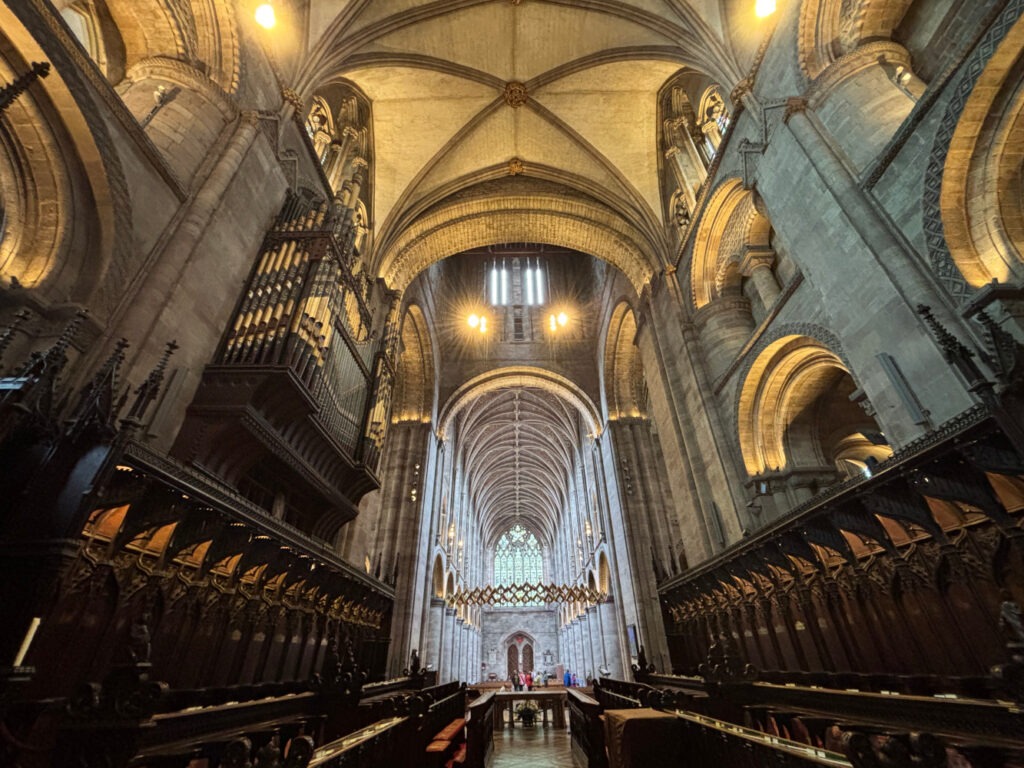
Image © Simon FitzGerald (aeolodicon.com)
This is a recording that stays in my collection for two reasons – it features the Willis organ in Hereford, sounding (as it always does) quite glorious, and it is the only (?) place to hear the Eclogue on the organ. The remaining works are almost surplus to requirements, but all allow the organ to shine, and Gower’s adept performances mean they ultimately contribute more than just acting as padding around the Eclogue. It’s a recital where the distinctive styles of Finzi and Walton are starkly juxtaposed, knitted into a most satisfying experience by Robert Gower and Priory’s recording engineer. Wonderful!