Album Details
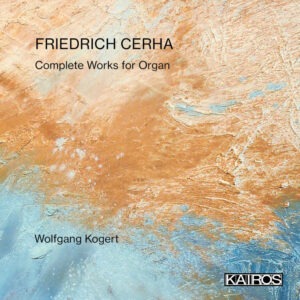
Friedrich Cerha – Complete Works for Organ
Wolfgang Kogert
Evangelische Kirche St Arnual, Saarbrücken, Germany
Jesuitenkirche, Heidelberg, Germany
ORF RadioKulturhaus, Vienna, Austria
Kairos Music (recorded 2014-2025)
Album Contents
Toccata
Neun Präludien
Neun Inventionen
Sechs Postludien
I only recently discovered Friedrich Cerha (1926-2023) through a compilation of various contemporary organ works (HORIZON) featuring his 2010 Toccata. Now, here is the complete organ works, 25 works in total, ranging from less than a minute duration through to the eight-minute Toccata.
Cerha, born in Austria where he spent most of his life, was a composer, conductor and teacher. He taught in Vienna’s Universität für Musik und darstellende Kunst for almost thirty years, at the same time pioneering a contemporary music movement within Austria through die riehe, an ensemble he co-founded in 1958. Interestingly, he also founded Camerata Frescobaldiana to focus on renaissance music, spending time to find and edit music for the ensemble. He composed many orchestral works and opera; a major contribution was Speigel, a 90-minute seven-movement cycle for large orchestral forces and tape, a milestone of modern avant-garde music.
The organ played no part in his large catalogue of compositions until the age of 85, and then, as the composer noted: “Suddenly – out of the blue – in November 2011, organ sounds arose within me, without any commission or request”. Until that time, although Cerha had made a few attempts with the instrument, he’d been unable to connect with it, unable to harness its sonic possibilities for his needs. To him, the grandeur of the organ and its sonic impact were at odds with his desires for clarity – an odd thought, perhaps, given his earlier works (including the ground-breaking Spiegel) seem quite at one with massive blocks of sound. It seems that in his last decade, Cerha realised the sparse, colourful clarity that the organ could offer.
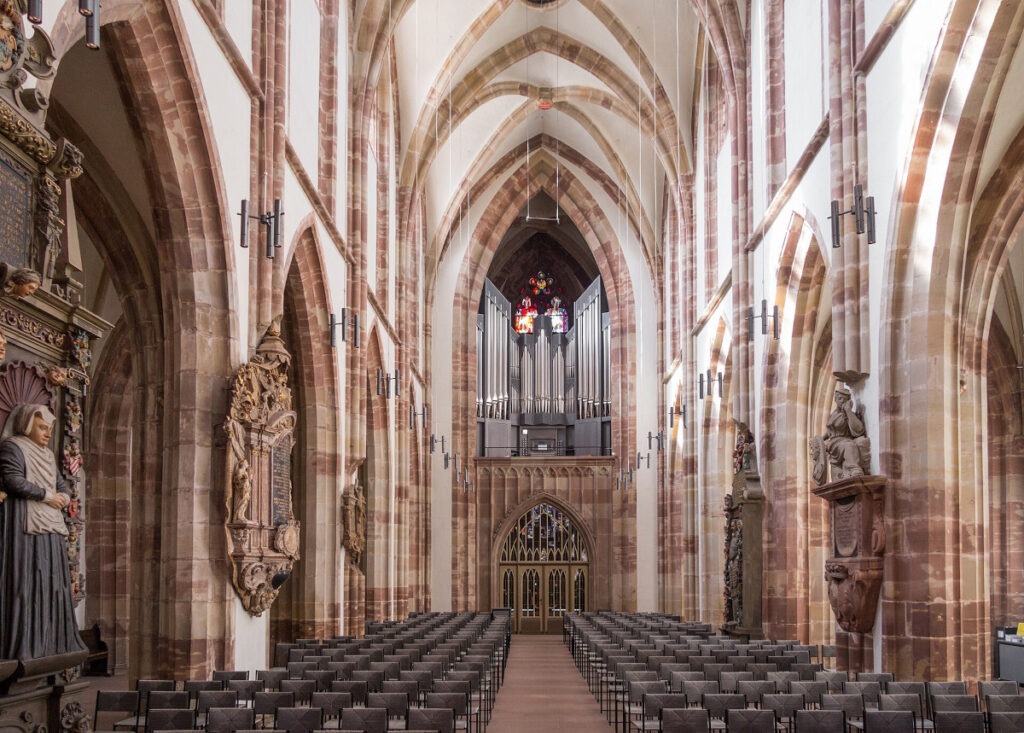
Image courtesy of Anna16, CC BY-SA 4.0 via Wikimedia Commons
The opening Toccata, like many contemporary examples, takes inspiration from the multi-sectioned baroque form. It explores the full sonic possibilities of the rather muscular, French-inspired three-manual Kuhn organ in St Arnual’s, Saarbrücken, with vibrant cornets, rich reeds and the quietest of strings frequently juxtaposed.
The two collections of preludes and inventions which follow are generally lighter in texture, character pieces that explore the many varied registers of the 1983 Karl Schuke organ in Vienna’s ORF Radiokulturhaus, a cultural hub including a concert hall with fine, albeit not expansive, acoustic. I had feared a rather brutal organ, but it complements the music well – the choruses are crisp but not painfully bright; and the smalls ensembles of flutes, mutations, and reeds are delicately coloured. Perhaps it is helped by the often spare demands put upon it by Cerha (and Kogert). As with the Toccata, rhythm and space are key compositional ingredients. As I listened, I was repeatedly reminded of Jean-Pierre Leguay’s writing – whilst his sonatas are often on a much larger scale, the short, introspective statements found in his Spicilège or Capriccio seem natural companions to Cerha’s musical thoughts for organ.
The six postludes which make up the final group are somewhat longer than the preludes and inventions that come before…more likely four or five minutes rather than one or two. All bar the first have titles…Die unbeantwortbare Frage (The Unanswerable Question), Scherzino, Capriccio naturale, Elegie and Endlich Schluss (Finally Finished). Wolfgang Kogert returns to another Kuhn organ, the 2009 three-manual insturment in Heidelberg’s Jesuitenkirche. A comparison of specification shows the very clear development of tonal concept in the 25-plus years since the Schuke organ in Vienna. Heidelberg boasts more foundations (including both German- and French-inspired flutes and strings), and orchestral colour reeds such as Clarinette. The church itself is large, and the organ is wrapped in a generously warm acoustic. The music maintains the fresh clarity and rhythmic invention that pervades everything on this recording.
Wolfgang Kogert is a sympathetic interpreter, with an obvious desire to share his love of Cerha’s music with others. He brings every work (large and small) to vibrant life, seeming to intentionally place the notes within the different acoustics, allowing space for reverberation to be part of the effect. I would guess this music isn’t for everyone, but the abstract nature of these numerous character pieces is, to my ears, rather beautiful. Supported by three fine-sounding instruments, Kogert makes a compelling case for Cerha’s characterfully voice in the catalogue of contemporary music.