Album Details
Nachthorn, for midi-controlled organ
Maxime Denuc (via computer-programmed midi control)
Katholische Pfarrkirche St Antonius, Oberkassel, Düsseldorf, Germany
Vlek (recorded 2021)
Album Contents
Edo — Maxime Denuc
Infinite end — Maxime Denuc
Düsseldorf — Maxime Denuc
Agoraphobia — Maxime Denuc
Ouverture — Maxime Denuc
Function music — Maxime Denuc
Papillons — Maxime Denuc
Fat old sun — Maxime Denuc
This is a most intriguing disc of organ meets computer meets dub techno! The composer-performer is Brussels-based Frenchman Maxime Denuc who explores the organ creativity through technological advances. My attention was drawn to his work through the 2020 album Solarium, a collaboration between Denuc and organist Cindy Castillo – the 90-minute ‘composition’, which starts and finishes with Baroque-inspired musical loops (Bach to begin; Buxtehude to end) with extensive improvisatory ruminations between. It was intended as a calming ‘after’, the period of slack following a lively, energetic night of techno. This current album, Nachthorn, is quite different, but equally thought-provoking and enjoyable.
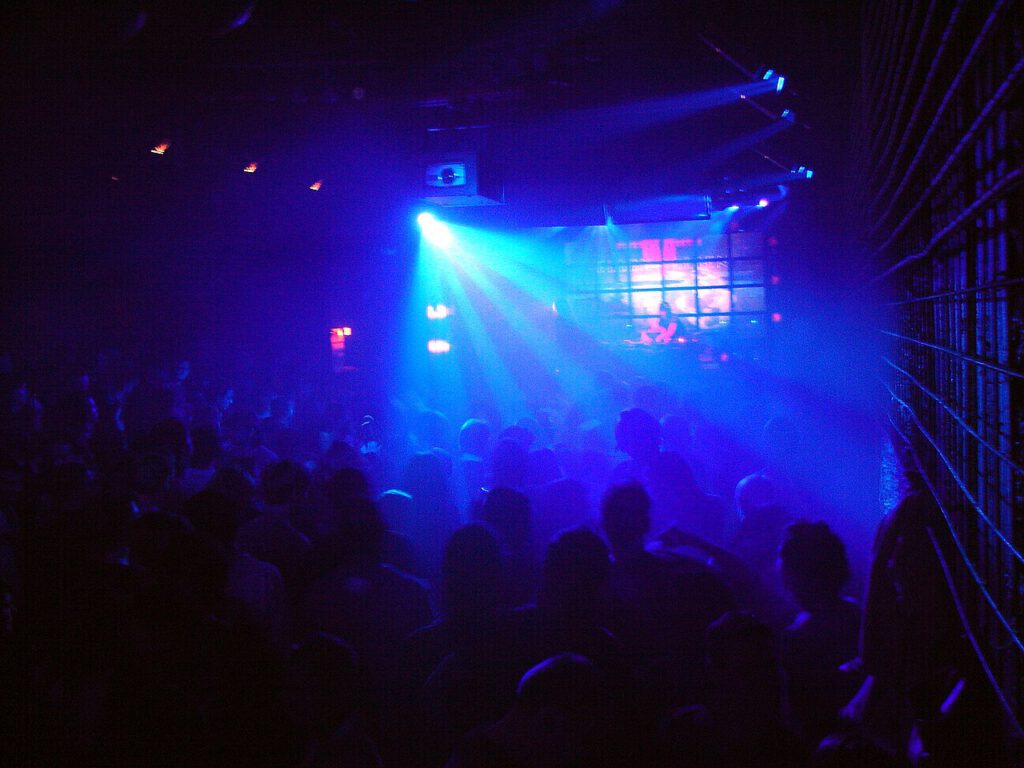
Denuc writes on his website that Nachthorn “[oscillates] between dub techno, harmonic locked grooves or after-hours pop [and] proposes a hypnotic music piece whose lines sketch the outline of an imaginary warehouse.” What does this really mean? He creates an entirely acoustic set of dance music, rhythmically pulsing with minimalistic repetitions, pushing the organ mechanism and its pipes to their very limits. He achieves this through midi control of the organ – there are no human fingers or feet playing the notes, instead it is all done through computer programming which then interacts directly with the organ’s windchests and pipes.
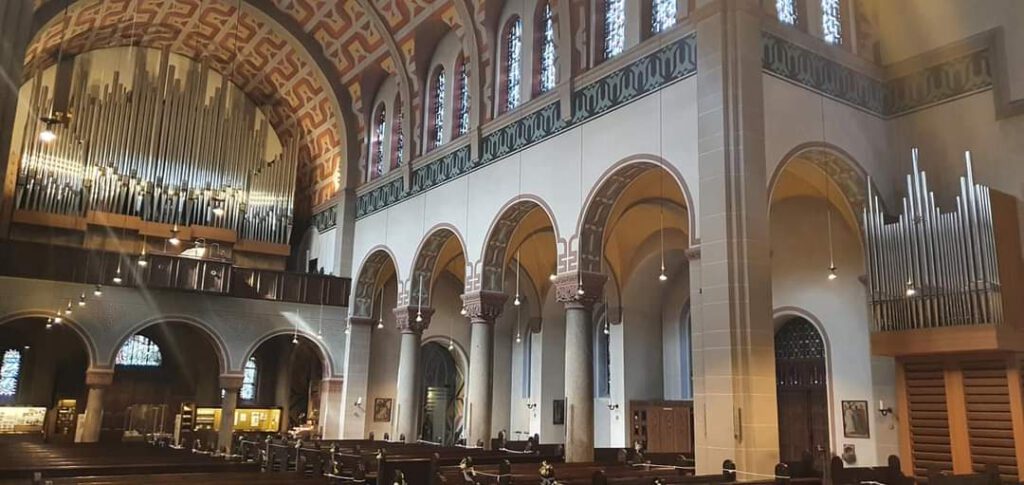
Image courtesy of Lukas Bölinger, CC BY-SA 4.0, via Wikimedia Commons.
Completed in 2016 the Orgelbau Mühleisen GmbH west-end Hauptorgel instrument in the cavernous church of St Antonius in Oberkassel, Düsseldorf, features everything you’d expect from a 21st-century grand eclectic organ, including four manuals and 108 speaking stops. But it goes way beyond normal expectations, with a 32′-based Hauptwerk, serried ranks of French- and German-inspired strings, pedal mutations at 6 2/5′ and 4 4/7′, and percussive vibraphon, marimba and carillon. There’s also a 20-stop east-end Chororgel (2012) and a newer 2018 Fernwerk placed in the attic space of the dome. And if that weren’t sufficient, at the heart of the organ’s electronic control is the SINUA system – this system removes any possible limitation that a traditional organ naturally imposes through its collecting of ranks into discrete divisions at discrete pitches. With SINUA, everything is available everywhere, and even the speech of pipes can be controlled – exactly as you can with a fine mechanical action where there isn’t a simple “on” or “off” for a pipe, but everything in between – from the merest hint of air moving, through gentle whistles to full speech. So an organ like this opens up a new dimension of creativity, particularly for artists like Denuc.
The result is, as I started this post, intriguing. It’s certainly exciting, and if a human being were directly engaged at the keys the description “virtuosic” would not be amiss. But it’s not really a human in control, its a computer and electronic circuitry…albeit doing the bidding of a human who has created and programmed to achieve a certain musical/aural affect. I suggested minimalism is part of the affect, but despite the limited musical material, constant repetition and machine-like pulses, it feels very different from the ‘traditional’ minimalist music that may spring to mind (by the likes of Philip Glass or Steve Reich). I have several recordings of ‘stasis’ compositions, long held notes and chords, and Nachthorn seems more akin to this…I think because there is very little harmonic movement, despite the often frenetic rhythmic motion.
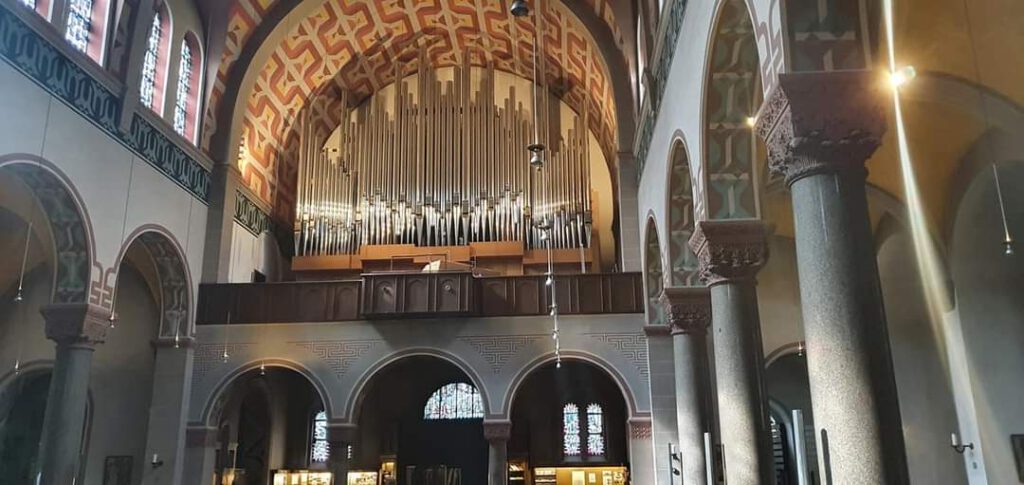
Image courtesy of Lukas Bölinger, CC BY-SA 4.0, via Wikimedia Commons.
The opening piece, Edo, begins with a block of sound on rich strings, to which is added slow moving notes on a gently contrasted registration – a quiet electronic-sounding ‘swirl’ sits atop, a slow and very smooth moving cluster which gives it an eerie out-of-this-world vibe. Infinite End which follows is quite a contrast – percussive repeated chords with circular motion, moving through different flute ensembles and then choruses; by the end a tenor theme comes to the fore, whilst the repeated chords subside.
Agoraphobia is a slow crescendo of pulsing chords; a percussive element is introduced adding a steady beat at adds and yet complimenting the main pulse – what this element is I don’t know. One of the organ’s percussion registers? A mechanical artefact from the organ being pushed outside of its comfort zone? Percussive speech of pipes? Whatever it is, it’s highly effective. Düsseldorf pushes repeated chords still faster, and at this point it begins to confuse ears which are so used to talented musicians playing music within the limits of brain power and muscle movement. Rapid figurations which make you wonder just how they are played, but with a computer traditional limits are lifted – at this point the organ starts to sound less familiar, definitely moving into that electronic “dub techno” world that the composer refers to in his notes.
The descriptions above may suggest that there is little variety – rapid pulsed chords in one piece, followed by slightly different rapid pulsed chords in the next – but each work has its own distinct character, and there’s no aural fatigue. The seventh track, Papillons, approaches the organ differently, with sweeping arpeggios punctuated by deep pedal ‘stamps’; and then the album concludes with Fat Old Sun, super-fast figurations of pipes not quite sounding properly, developing into a swirling rush of notes slowly creeping up the scale. It disintegrates into high-pitched mixture work and without warning ends.
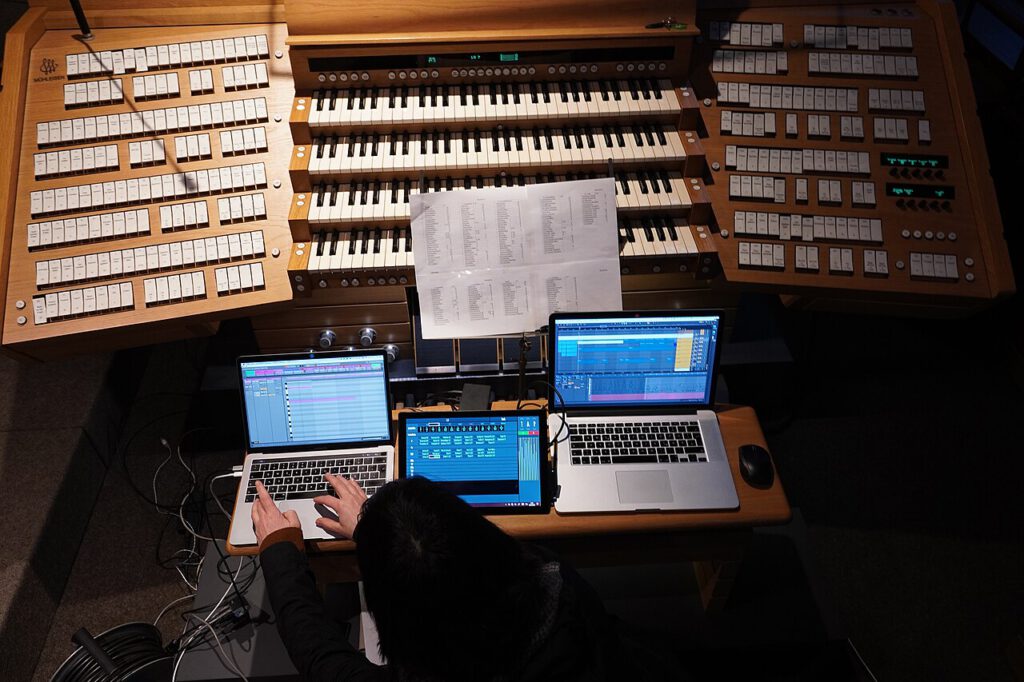
Image courtesy of Rizomozir, CC BY-SA 4.0, via Wikimedia Commons.
What I find interesting is how the computer-controlled absolute rhythmic perfection is so effective. Within my collection I have a recording of an Aeolian player organ, where punched musical rolls define what notes get played when. The flaw in this type of automated organ is that it has none of the rhythmic feeling that a performer adds to the music – works by Brahms, Tchaikovsky and Wagner become dull robotic equivalents of their normally exhilerating selves. But with Nachthorn, the automated precision is part of the appeal – this is not ‘normal’ organ music being played by a computer; it is a new type of organ music where that robotic precision and speed are an inherent part of its success.
The organ’s sonic capabilities aren’t displayed in the normal way and, for one that is so large and rich, it is under explored. We hear blocks of sounds, sometimes with subtly terraced contrasts (flutes against flutes, principals slowly building up to mixture work), but wouldn’t it be wonderful to hear the contrasts, and hear unleashed the powerful might that its specification promises. The possibilities of this midi-controlled organ are unlimited, but Nachthorn barely scratches the surface.
This is an unusual album, showcasing a unique creative voice that’s taking the pipe organ down new paths. It won’t be for everyone, but this is an album that I for one return to again and again.