Album Details
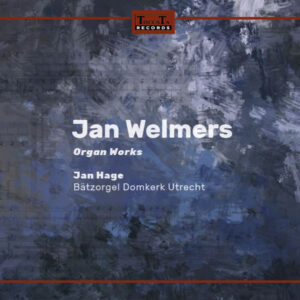
Jan Welmers – Organ Works
Jan Hage
Domkerk, Utrecht, the Netherlands
Toccata Records (recorded 2017)
Album Contents
Laudate Dominum — Jan Welmers
Partita: O grote Christus, eeuwig Licht — Jan Welmers
Passacaglia — Jan Welmers
Monologen — Jan Welmers
Invocazione — Jan Welmers
Psalm 142 — Jan Welmers
Von Gott will ich nicht lassen – nachtmusiek — Jan Welmers
Sequens — Jan Welmers
Zes Koraalvoorspelen voor Advent en Kerst — Jan Welmers
Sferen ’70 — Jan Welmers
Vater unser himmelreich — Jan Welmers
Veni creator spiritus — Jan Welmers
Memories II — Jan Welmers
Litanie — Jan Welmers
Reflectie — Jan Welmers
Movements — Jan Welmers
Monologen en dialogen — Jan Welmers
Lichter en Donker II: Te Deum — Jan Welmers
I first encountered Jan Welmers’ organ music on a disc by Audite, featuring just four relatively long pieces. The disc grouped them as minimalist, and they certainly do feature the characteristic repeated patterns of sound, but they are something much more than this. Welmers combines those simple elements of minimalism with a rich twentieth century harmonic palette and vast, slow-moving dynamic shifts. This new recording by Jan Hage of Welmers’ almost complete organ oeuvre shows several other facets to this fascinating composer, including 12-tone and serial methods, 1960/1970s experimentation, and Christian chorale-based works.
Born in 1937 in the Netherlands, Welmers was immersed in music from an early age, his father being an organist and choral conductor with a great interest in new music. He studied piano and organ at the conservatories in Groningen and Utrecht, counting Wim van Beek, Ton de Leeuw and Cor Kee amongst his teachers. He won the National Organ Improvisation Competition in Bolsward in 1968, whilst organist in Katwijk aan Zee; he subsequently moved to St Stevenskerk in Nijmegen for a 28 year tenure as . He was appointed to the organ department of the Utrecht Conservatory in 1974, remaining there until 1998. Thereafter he dedicated his time to composition – he won the prestigious Jan Pieterszoon Sweelinck Prize in 2005, recognising his entire oeuvre and the its national and international significance to organ culture.
A fascinating view of a unique compositional voice
Jan Hage is a compelling advocate of Welmers’ varied music, helped in no small part by the glorious 1831 Bätz organ in Utrecht Dom. This instrument boasts a rich heritage that spans nearly seven centuries, combining Renaissance artistry with 19th-century engineering. While the cathedral’s first recorded organ dates back to 1342, foundations of the current instrument was laid between 1569 and 1571 when builder Peter Janszoon de Swart constructed a new organ for the cathedral. Remarkably, eleven stops and over a thousand pipes from De Swart’s 16th-century masterpiece survived subsequent centuries of political upheaval and structural changes to the cathedral. By the early 1820s, the aging instrument required a complete overhaul, and the renowned local firm Bätz was commissioned to construct a magnificent new organ, which they completed between 1825 and 1831. They expertly integrated De Swart’s historic Renaissance pipework into their new creation. Architect Tieleman Franciscus Suys designed the striking, monumental neo-classical case that still houses the instrument today. Subsequent changes made during the 19th and 20th centuries were reversed by van Vulpen in the 1970s, leaving us with the wonderful instrument heard on this recording.
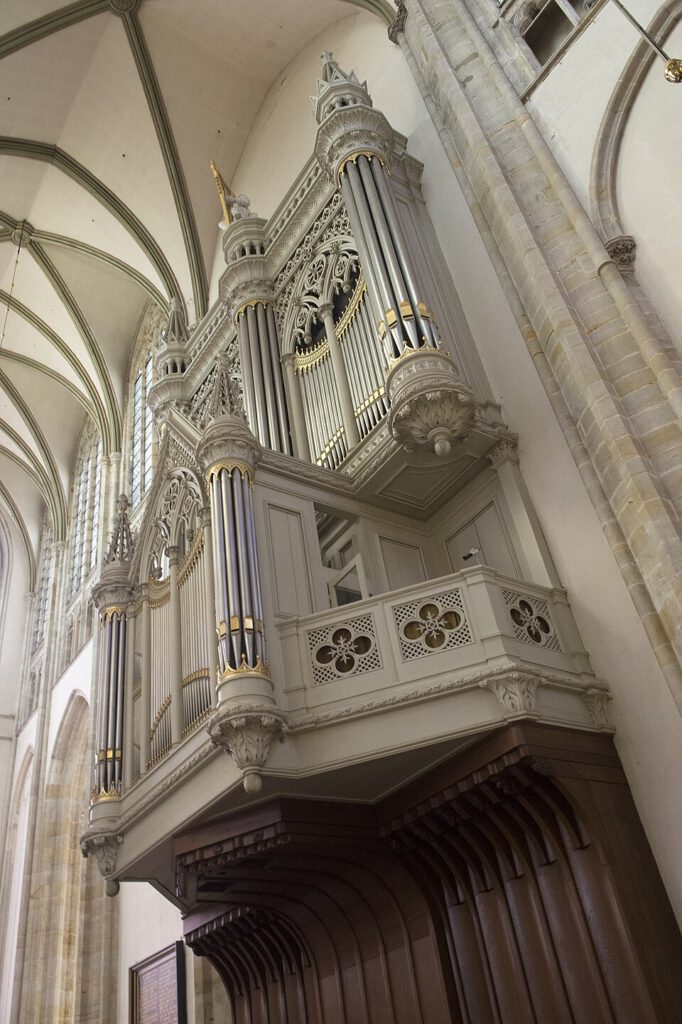
Image courtesy of Dosseman, CC BY-SA 4.0, via Wikimedia Commons.
It is one of those rare instruments where every individual register is an absolute delight to listen to, where everything contributes, and where the quietest and loudest ensembles are as musical as each other. The delicate luminosity of the flutes and strings are heard in Welmers’ serene 1984 Monologues, a collection of five duets and six trios which Hage splits into groups of two or three pieces across the three discs of this album. Although based on a type of redacted serialism, labelling with compositional style seems superfluous – these are spare, timeless utterances which, whether individually or as a full collection, work beautifully. A similar sense of abstract stasis is felt at the start of the 1987 Monologen en dialogen, although more complex, spirited moments play a significant role, including loud blocks of tangled sound in the climax. The concluding bars return to peace. I must admit that from everything on this album, this is the work which I find most difficult to digest. Another serially composed work is Movements from 1990, five short sections which Jan Hage identifies, in his liner notes, with an overall mood of withdrawal and peace. It explores ostinato rhythms, monophony, abstract punctuations of sound linked through long melodies, and sparkling arpeggios. Here, Welmers again successfully blends subtle organ colour and static contemplation into something far greater than the spare notation would suggest.
In his excellent liner notes, the performer Jan Hage groups Welmers’ music into five genres – (1) functional chorale-based pieces, (2) contemporary, (3) monologues and dialogues, (4) quotation music and (5) repetitive music. This is a logical approach, and I’ll borrow it here, with monologues and dialogues already covered above.
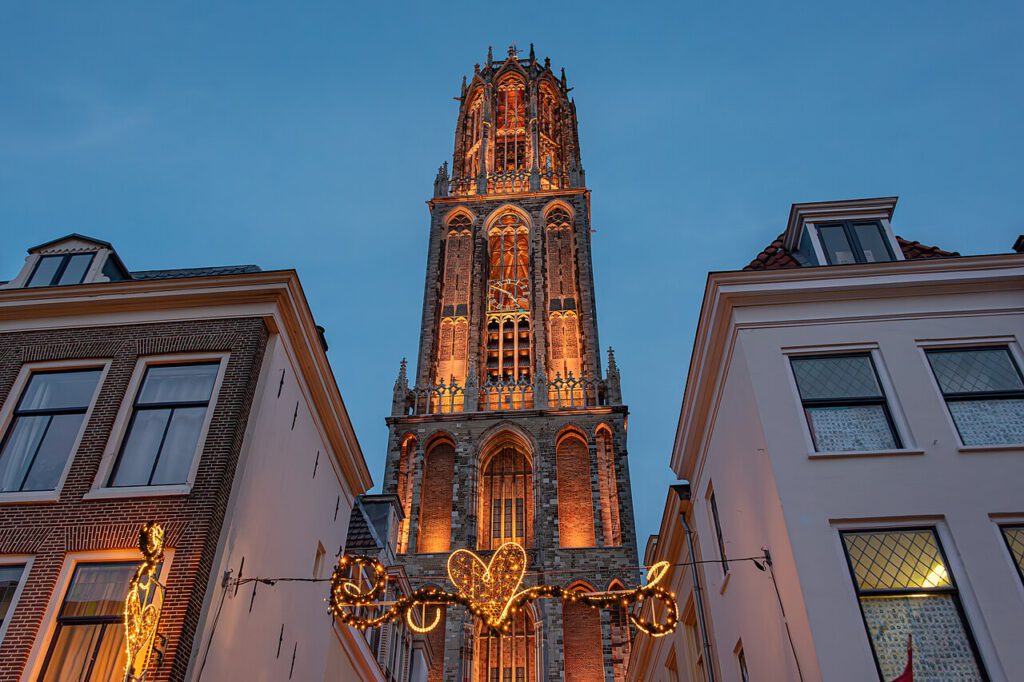
Image courtesy of Jorge Franganillo, CC BY 4.0, via Wikimedia Commons.
Chorale-based ‘functional’ works are amongst Welmers’ first, dating from the 1960s and contributing to the renewal of Dutch psalmody in those decades, which looked backwards to the 16th Genevan Psalter for original melodies with fresh translations of the texts. With the exception of the much later 1991 Psalm 142, the early chorale preludes feel exploratory, musings from the pen of a composer working to discover his own style. They are well crafted, but miss the exciting fusion of styles which make Welmers’ mature work stand out. Psalm 142, however, is beautiful – a sombre reflection on the dark text, with its opening stanza:
With all my voice to God I cry;
I call upon the LORD Most High.
Before His face my grief I show
And tell my trouble and my woe.
It should be noted that Welmers features chorale melodies in many other works outside of this Hage group. Welmers’ “quotation” music is one example – the 1988 Von Gott will ich nicht lassen – Nachtmuziek in this group is fascinating; from a meandering start with mildly dissonant drones in the bass; a held note heralds a direct quotation of Bach’s tranquil Orgelbüchlein prelude (BWV 658) but this soon loses its baroque track and comes back to spirited Welmers. Another hiatus allows Bach’s calm to be re-established. The music builds to a Welmers (rather than Bach) climax which then evaporates to quieter Bach, leaving Welmers to have the tranquil last word.
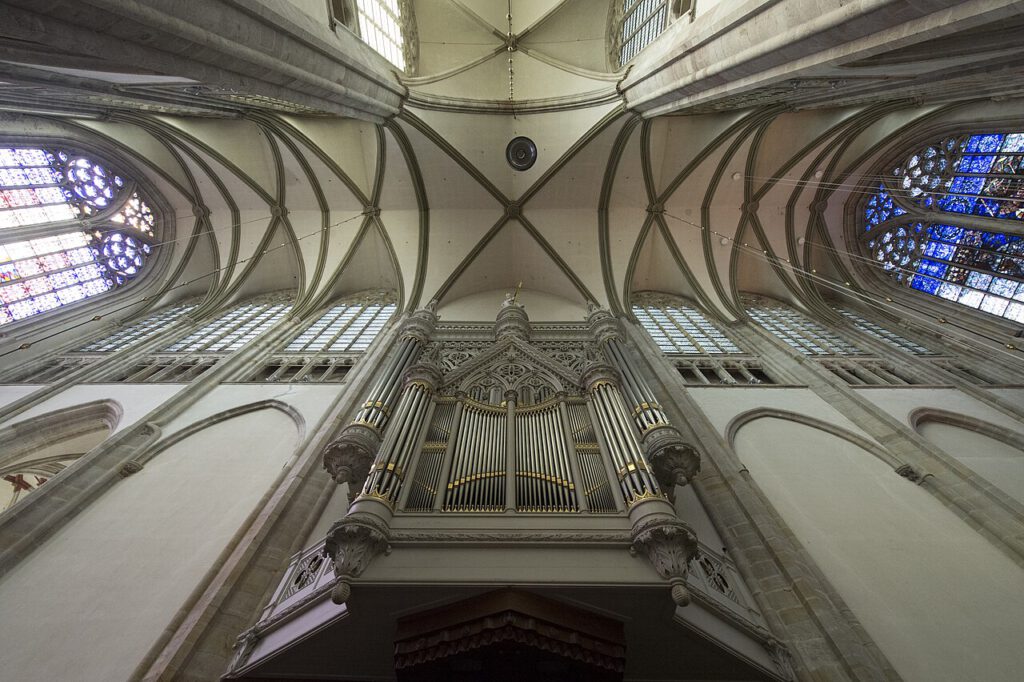
Image courtesy of Dosseman, CC BY-SA 4.0, via Wikimedia Commons.
The earlier 1977 Transformaties is more adventurous, packing in six quotations from different periods. As Jan Hage notes, “the listener undertakes a sort of musical journey along beacons of music history” with music from the 14th, 16th (Nun komm der Heiden Heiland), 17th (Jacob Praetorius), 19th (Max Reger) and 20th (Eric Satie) centuries all acting as pivot points. When the earliest Stantipes (or Estampie) bursts forth with its characteristic medieval harmonies and rhythms, its really quite exhilarating, like sunlight suddenly shining through dark storm clouds. By the end, as the Kyrie from Satie’s Messe de Pauvres is sung by an uncredited choir, you certainly do feel like you’ve safely completed a real journey in Welmers’ compositional hands.
And we can step a year back to the 1976 Reflectie, which stitches melodies based on medieval modes with the BACH notation, hints at psalm tunes, and quotes Mein junges Leben hat ein End. Once again, there is a sense of timeless stasis initially, before energetic BACH figurations take hold. Welmers creates a rich patchwork of musical thoughts – it is a testament to his skill that despite their disparate nature a work of satisfying musicality is the result.
Hage’s “contemporary” group is dominated by the 1970’s Sferen ’70, Welmers’ taking inspiration from the experimentation that was all around him. Hage notes the commonalities to Ligeti’s pioneering 1962 Volumina, although points out that Welmers was probably unaware of the music when he composed Sferen. Like Volumina, Welmers’ work uses graphical notation with duration of notes based upon their length along the page. Clusters, use of mechanical stop action for partially sounding registers and unusual registrations certainly indicate an affinity with Volumina, but Welmers’ takes a slightly more ‘conventional’ path with traditional chords complemented by twelve-note series – Ligeti’s Volumina approaches the organ as sound synthesiser; Welmers still makes use of individual pitches. It’s an exciting work that immediately conjures up the exciting and experimental years of the 70s.
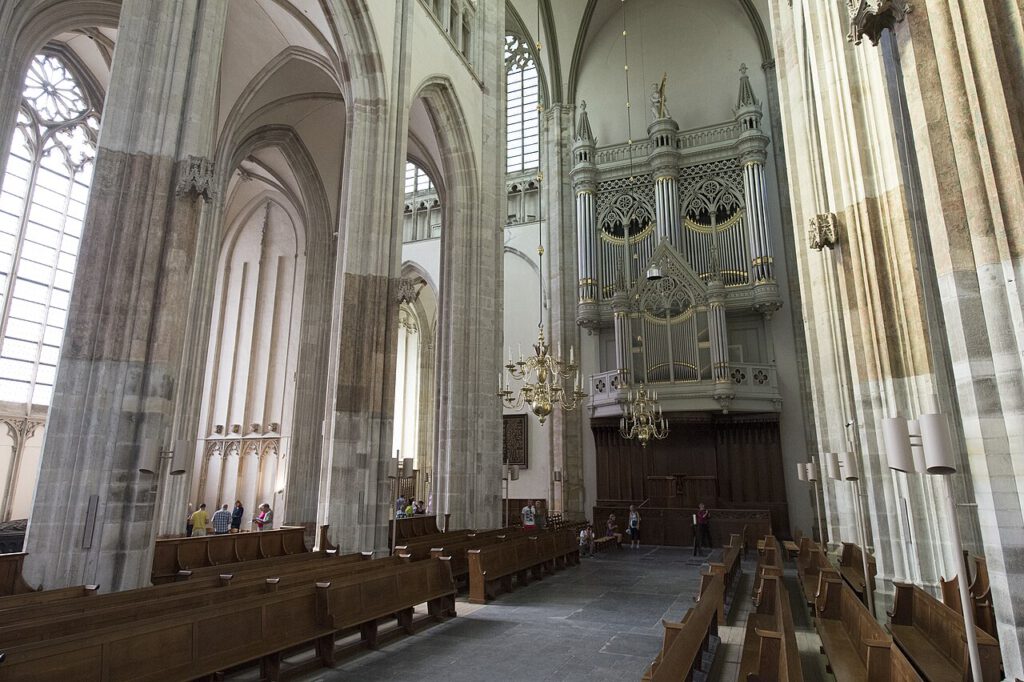
Image courtesy of Dosseman, CC BY-SA 4.0, via Wikimedia Commons.
Also in this group is the 1965 Passacaglia; less ‘contemporary’ perhaps, but a work which I return to again and again. This is not a passacaglia in its traditional form with a repeating bass line, rather Welmers creates a twelve-tone ‘theme’ which loosely binds the whole together, despite rhythmic invention, sudden registration changes, and stark textural contrasts. Its a strikingly original work that explores everything the Utrecht organ has to offer. The unusual end (a huge climax; sudden fortissimo chord; and a final ‘rain’ of individual notes which abruptly stop) never fails to surprise and delight.
There are two works which, more than the others, belie neat categorisation. Lichter en Donken II – Te Deum is part of the monument ‘Light and Darkness’ cycle, six large-scale works for varying musical forces. This Te Deum was written for the 1996 inauguration of the restored organ in Alkmaar’s Grote of St Laurenskerk. It retains Welmers’ typical contrasts of fleeting notation, quiet reflection and impassioned climaxes, with the Te Deum theme present throughout, including a glorious peroration by the, presumably same, uncredited choir.
And so we come to Hage’s final group, repetitive music…where my encounters with Welmers first began. Within this group sit Laudate Dominum (1979), Sequens (1979), Litanie (1982), and Invocazione (1989). These are immense works (at c.13 mins, Laudate Dominum is the shortest, whilst Sequens lasts some 20 minutes), and, as mentioned at the start, are more than just minimalism. Sequens is a perfect example – it opens with a quiet held chord which slowly creeps across the keyboards, whilst a fluid medieval-sounding theme is repeated heard in different registers. A more animated (still medieval inspired) figuration starts…and here the repetitive nature of the music becomes clear, through a dialogue between to strands which subtly vary themselves throughout whilst maintaining a clear identity. The creeping chords return, this time with repeated flute figurations. From here, the work builds and builds, eventually reaching a climax of pulsed chords and rapid outbursts of the medieval notation. The energy is quickly dispelled, dying down to spaced out short figurations which fade to nothing. The melodies, harmonic developments, and dynamic development makes this something much more powerful than traditional minimalism. This is Welmers inventing something new!
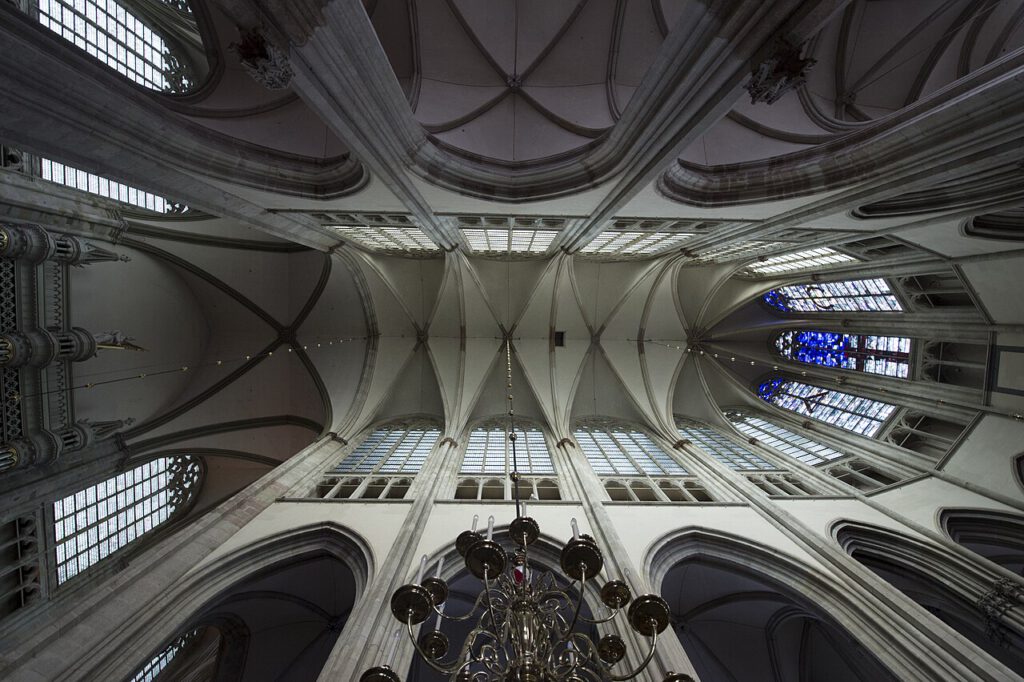
Image courtesy of Dosseman, CC BY-SA 4.0, via Wikimedia Commons.
Laudate Dominum was Welmers’ first repetitive work, already inventive with his use of challenging tremolo notation fused with the Genevan Psalm 117 melody. By the end, it builds to a huge climax, three superimposed tonal centres creating tense dissonance. Litanie and Invocazione both continue in the same vein. Litanie starts with a sense of calm but (in the composer’s own words) transforms to a hard and threatening soundscapre; Invocazione uses a serially developed motif placed against a repeating note (A). Both build to climaxes before ending quietly.
I’ve written much about the music, and hinted at the beautiful organ – the Bätz is enveloped in the warm acoustic, able to produce at one moment the most tranquil flute timbres floating through the building, at the next pungent mutations, richly colourful reeds, and when needed an exhilarating grandeur. An 1831 Bätz organ may not be an obvious choice for a programme of so clearly modern music, but it all works superbly – a lesson, perhaps, not to pigeonhole instruments by genre or date!
Jan Hage, a master of technical wizardry and artistic depth, gives absolutely stunning performances
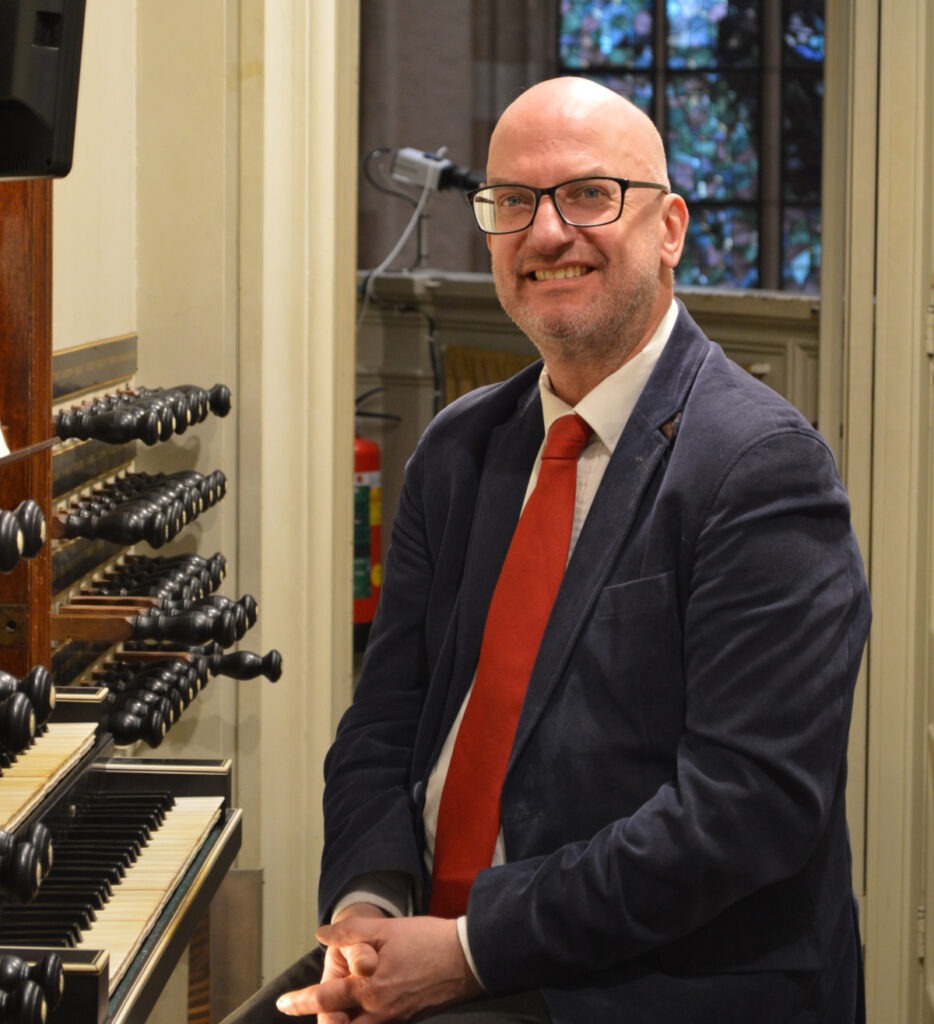
Mention must also be made of Jan Hage – the three and a half hours of music on this album requires virtuosic technique, and he delivers with impassioned performances that serve this innovative composer to the full. He has served as the main organist for Utrecht Domkerk since 2011, allowing him a familiarity with this wonderful organ that surely contributes to its successful translation to Welmers’ inventive writing. Hage’s prestigious musical pedigree includes a Premier Prix from the Conservatoire National de Région de Boulogne-Billancourt in France, as well as a PhD from the Protestantse Theologische Universiteit with the dissertation ‘Music as mission. A Lutheran sound in a Calvinist world. A study of Willem Mudde and the church musical renewal movement.’ First prizes at major organ competitions in Leiden, Schaffhausen, and Poitiers confirmed the virtuosic talent which is so evident in this recording. Whilst some of the featured music is slow and sparsely notated, other works are fiendishly complex – Hage is on top of it all, and gives absolutely stunning performances.
The success of this album is three-fold; it provides a fascinating view of a unique compositional voice, exquisitely voiced by the Utrecht Bätz organ, and played by Jan Hage, a master of technical wizardry and artistic depth. Brilliant!