
Album Details
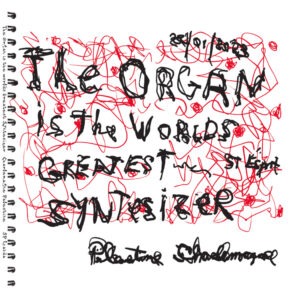
The Organ is the worlds Greatest Syntesizer
Charlemagne Palestine
Oude Kerk, Amsterdam, the Netherlands
Staalplaat (recorded 2024)
Album Contents
The Organ is the worlds Greatest Syntesizer (2024) — Charlemagne Palestine
Within the world of contemporary avant-garde music, Charlemagne Palestine is a unique voice, someone who challenges traditional American minimalism, aiming for an emotionally charged alternative that he calls ‘maximalism’. Whereas minimalism prioritises mathematical precision, structural transparency and rhythmic phase-shifts, maximalism seeks sonic saturation in such a way that a performance is an act of endurance combined with an air of spirituality.
This maximalist philosophy flourishes within his monumental, ecstatic organ performances that were born in the 1960s. As in the title of this album, Palestine rejects digital trickery and promotes the organ as the world’s greatest synthesizer – one that can fill an enormous space with a hugely variable soundscape. His attraction to the instrument is because, as he commented before a performance at Lewis & Clark College’s Agnes Flanagan Chapel in 2015, it is one of the few that can move “real air in real space” without electronic amplification. The sonic capabilities of the organ for unending sound, intentional variety of pitch and timbre, and (with instruments equipped with mechanical stop action) unintentional tone creation through partially and/or slowly drawn stops, provides Palestine with an acoustic laboratory.
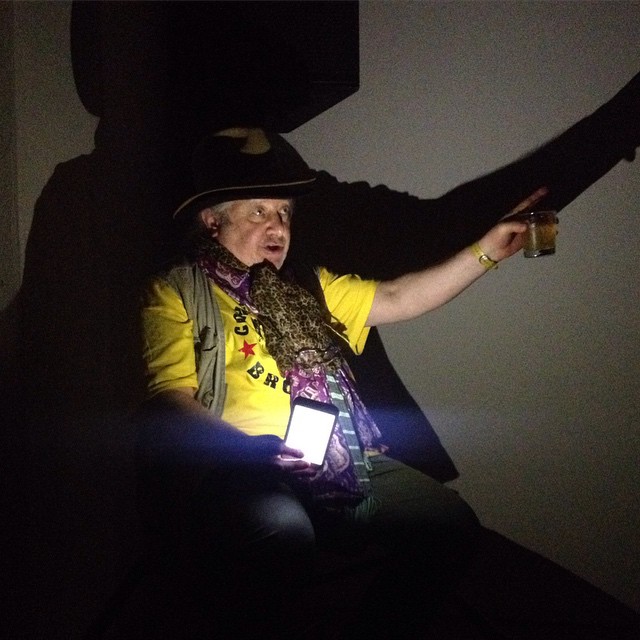
Image courtesy of Evan P. Cordes, CC-BY-2.0, via Flickr.
In Schlingen-Blängen (formulated in the late 1970s as a lifelong ‘Organ Continuum’), Palestine utilizes custom cardboard or wooden wedges to physically hold down notes at the console, allowing him to sustain complex, microtonal chord clusters indefinitely, gradually shifting stops and registers over several hours to trigger massive, cascading overtones. On Valentine’s Day 1998 he offered a six-hour performance (with long-time collaborator, the post-modern dance pioneer Simone Forti) at Hollywood Methodist Church, Los Angeles, starting a midnight. The reality of this sonic ritual, entitled Schlongo!!!daLUVdrone, proved a little too much for the performers resulting in a premature 2.30am finish…a unique and mammoth endeavour nonetheless!
Born Chaim Moshe Tzadik Palestine in 1945, in Brooklyn, New York, Charlemagne Palestine began his musical endeavours as a sacred singer (cantor) in local synagogues and a multi-instrumentalist in Greenwich Village’s vibrant avant-garde scene. New York served as his base for his early work in the 1960s and ’70s; for seven years he was the carillonneur at Manhattan’s Saint Thomas Episcopal Church ringing bells over Fifth Avenue. In this role he was tasked with a daily one-hour performance, of which 15 minutes were stipulated to be hymns, and the remaining time free for him to do as he wished. This being Charlemagne Palestine, those 45 minutes allowed him to develop an extraordinary improvisatory style, named by him as ‘klanggdedangggebannggg’, with frantic, ecstatic pounding of the 26 bells filling the Fifth Avenue environs. It was clear to many that something unique was happening…the likes of John Cage would regularly gather to listen.
In the 1980s, Palestine retreated from public, a result of finding himself creatively at odds with the rigid, increasingly institutionalised New York music world – he focused instead on visual art. In 1995 he moved to Europe, seeking a more receptive cultural climate for his expansive projects, and settled in Brussels in 1999.
an inexorable increase in volume, and with it, tension – a mesmerising experience
The Organ is the worlds greatest Syntesizer is a more recent creation, with this Staalplaat recording being from an early morning performance in Amsterdam’s historic Oude Kerk as part of the 2024 Sonic Acts Biennial. There is an interesting tension here…Sonic Acts was launched in 1994 as an annual festival to ‘present new developments in electronic and digital art forms’, switching to a biennial format in 2022 – as noted above, Palestine seeks out true acoustic expressions, hence his love of the ‘real’ sound of the organ. And yet, in Sonic Acts, Palestine performs.
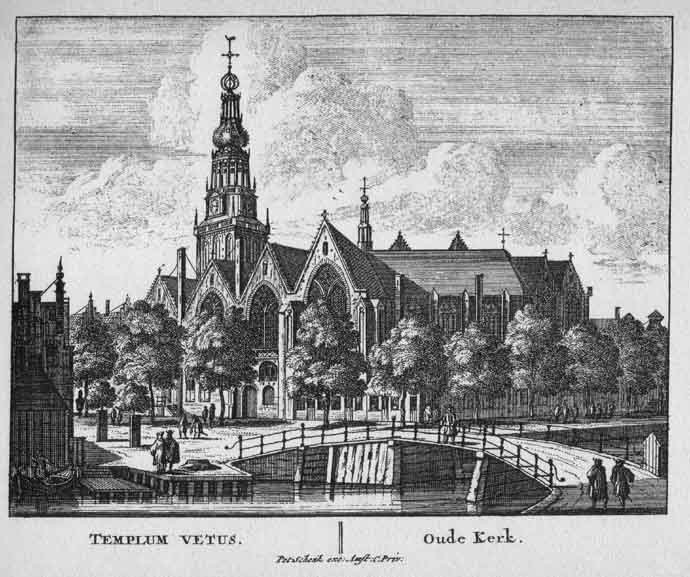
Image public domain, via Wikimedia Commons
At 8.00am on Friday 1st March 2024, a bell tone marks the start of a musical journey; simultaneously a quiet organ drone, gently dissonant, sounds, and a few seconds later Palestine’s signature overtone singing strikes up. In these first minutes he explores the variety of tone and expression the human voice uniquely offers, with vowels and timbre fluidly developing in long melodic lines, a dialogue between loud forthright statements and quiet hesitant echoes – the handbell returns several times providing percussive punctuation. The droning pipes continue unabated.
From here, the singing stops and the remaining forty minutes are dedicated to a gradual crescendo. At times there are almost imperceptible additions of stops, often slowly drawn so that pipes reach full speech through breathy whistles and out-of-tune undulations. Occasionally, new timbres are introduced more distinctly, standing out as way markers in an otherwise meandering tonal adventure – at one point a reed coming on resembles the wheezing start-up of bagpipes.
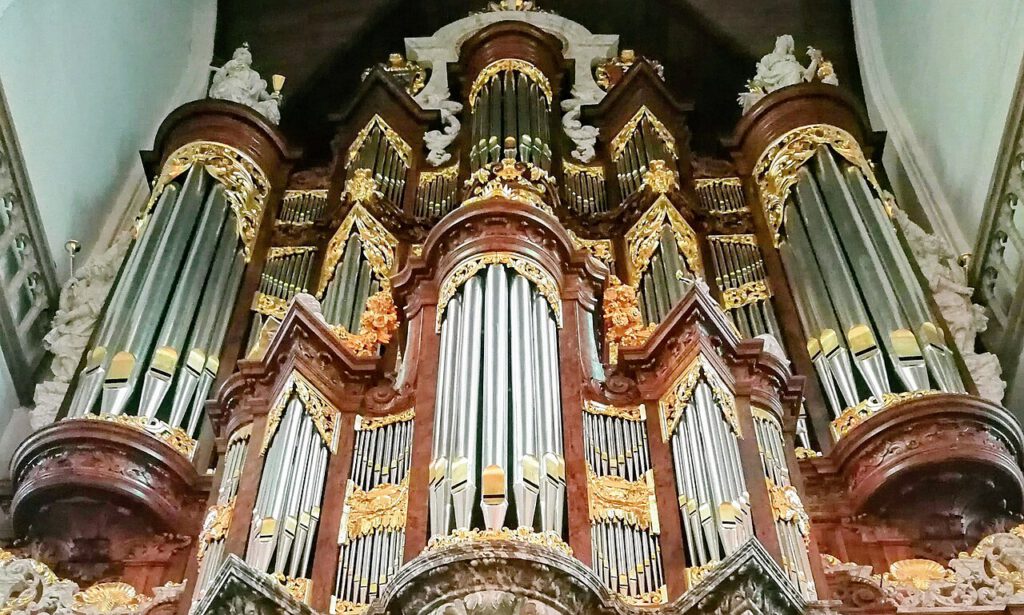
Image courtesy of Subbass1, CC-BY-SA 4.0, via Wikimedia Commons.
There’s not much more to say. There’s no melody, no real rhythm – simply an inexorable increase in volume, and with it, tension. As with other ‘living creations’ by Palestine, like Schlingen-Blängen and Schlongo, the greatest Syntesizer is a mesmerising experience. His music has been described at times as ritualistic, trance-inducing, and even sacred – it’s easy to hear why, remarkable in a way given the sparse material at play.
The conclusion is sudden – there is a stepped drop in volume, and within a few seconds silence. From that silence, applause emerges building to cheers…and then…a magical moment. Palestine’s distinctive voice reappears, sounding more distant than at the start. The applause stops, and it’s the voice which closes proceedings. Is this the greatest synthesiser in the world?
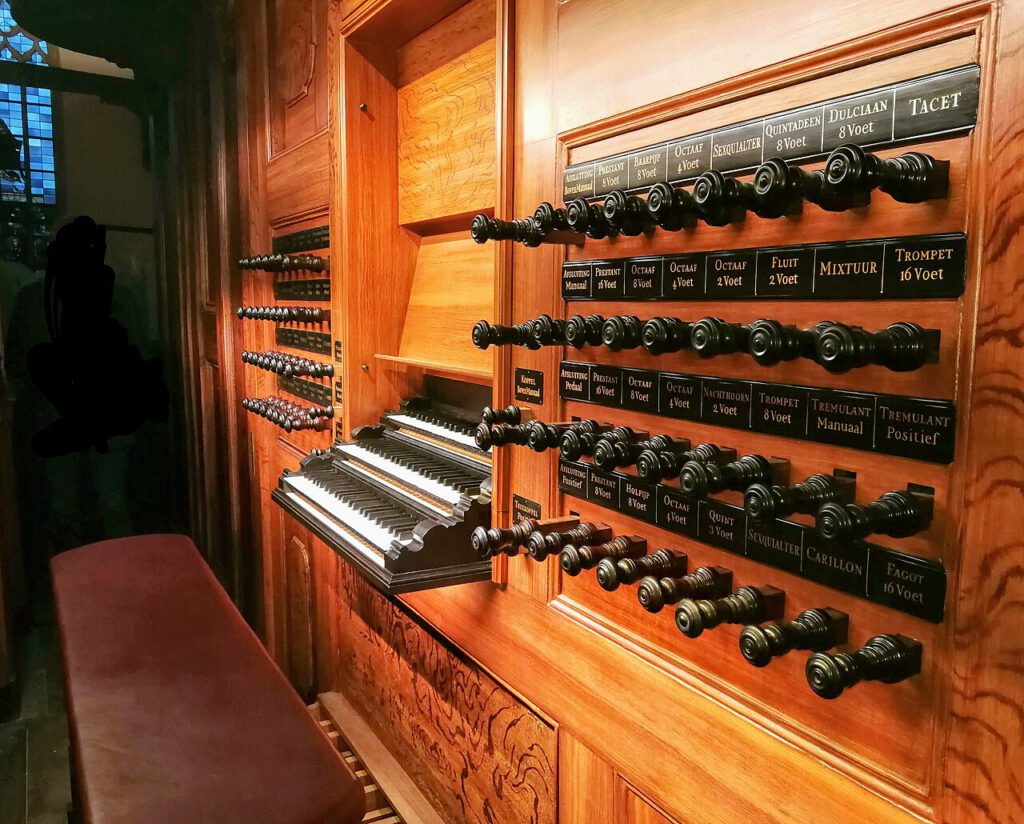
Image courtesy of Subbass1, CC-BY-SA 4.0, via Wikimedia Commons.
I noted that, 44 minutes prior, a journey started, and in that final silence it does feel that you’ve gone through something, despite the lack of any real musical progression. It’s music, Jim, but not as we know it! What I do miss though, despite the journey, despite the tension, despite its mesmeric nature, is properly experiencing the organ. The rich foundations, brilliant choruses, and colourful reeds of the Vater-Müller organ can’t be appreciated. They’re included, of course, but only as part of Palestine’s synthetic soundscape and we don’t hear what this wonderful organ really offers. This is a shame, because here we have a beautiful, historic instrument – built by Christian Vater in 1726 to replace an older instrument that Sweelinck knew and played, it was soon expanded in 1738 by Johann Caspar Müller, taking advantage of the need to dismantle the instrument to address structural issues with the church tower. Bätz did additional work in 1870, and it is this blended instrument that survives today, comprehensively restored by Reil between 2015 and 2019. I suppose that Palestine’s intent is something quite different – the organ is a vehicle for something more than a showcase of a historical sound world, and if you want that sonic record of what Vater, Müller and Bätz carefully created there are other albums that do just that.
The Organ is the worlds greatest Syntesizer offers something very different. It won’t be for everyone, but I find it intriguingly enjoyable.
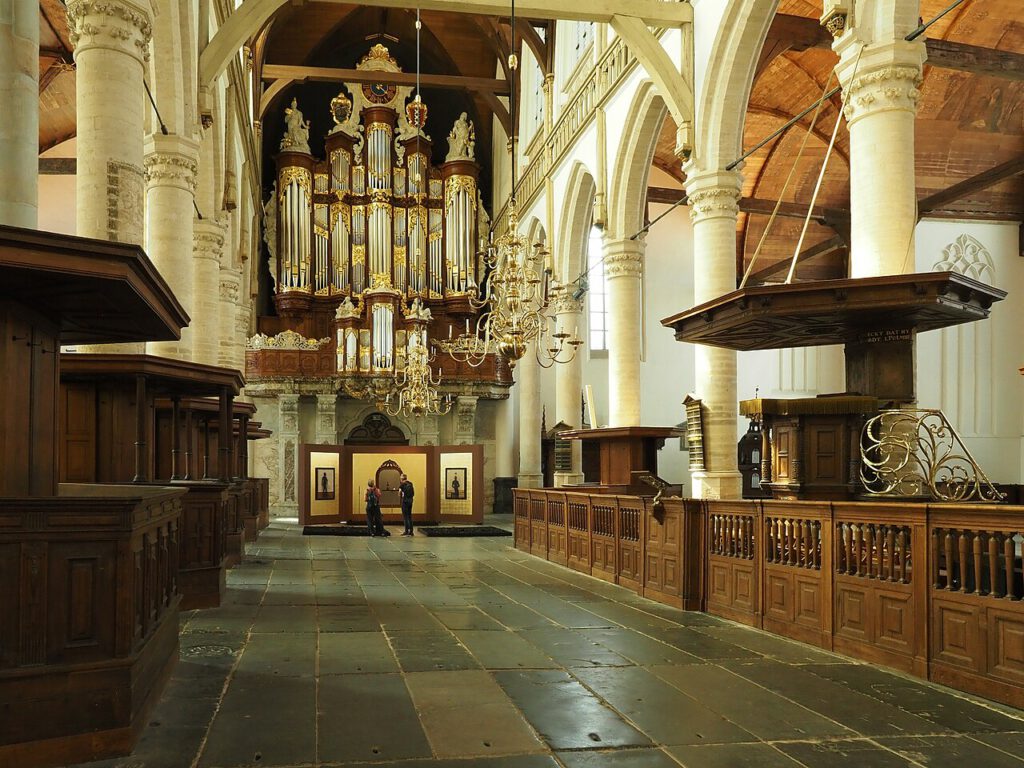
Image courtesy of Jedesto, CC-BY-SA 4.0, via Wikimedia Commons.