Album Details
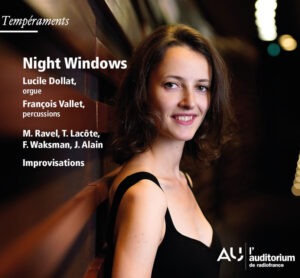
Night Windows
Lucile Dollat (with François Vallet, percussion)
Grand Auditorium, Maison de la Radio et de la Musique, Paris, France
Tempéraments (recorded 2023)
Album Contents
Alborada del gracioso (from Miroirs) — Maurice Ravel
Songes Improvisés — Lucile Dollat
La nuit sera calme — Thomas Lacôte
Night Windows: Three Paintings after Richard Pousette-Dart — Fabien Waksman
Aria — Jehan Alain
Litanies — Jehan Alain
The years 2014 and 2015 saw a cultural regeneration and blossoming in Paris, with the opening of two large concert halls at the Philharmonie de Paris and the Maison de la Radio et de la Musique. The former was part of a new development, whilst the latter was a reworking of Radio France’s iconic 1963 ‘maison ronde‘ headquarters in the 16th arondissement. Within a year or two, each venue had a brand new organ to celebrate – a four-manual 91-stop Rieger for the Philharmonie, and a four-manual 87-stop Grenzing for the Maison. Since then, a number of recordings have been issued on both instruments, of which, at the time of writing, Night Windows is the most recent.
The two institutions are separately administered and serve different functions. The Philharmonie is the city’s flagship international concert venue, home to the Orchestre de Paris, and run as an independent cultural institution. The Maison is the national broadcasting centre for Radio France, and home to the Orchestre National de Paris and the Orchestre Philharmonie de Radio France. The Philharmonie and Maison may be separate institutions but they are two musical powerhouses in Paris.
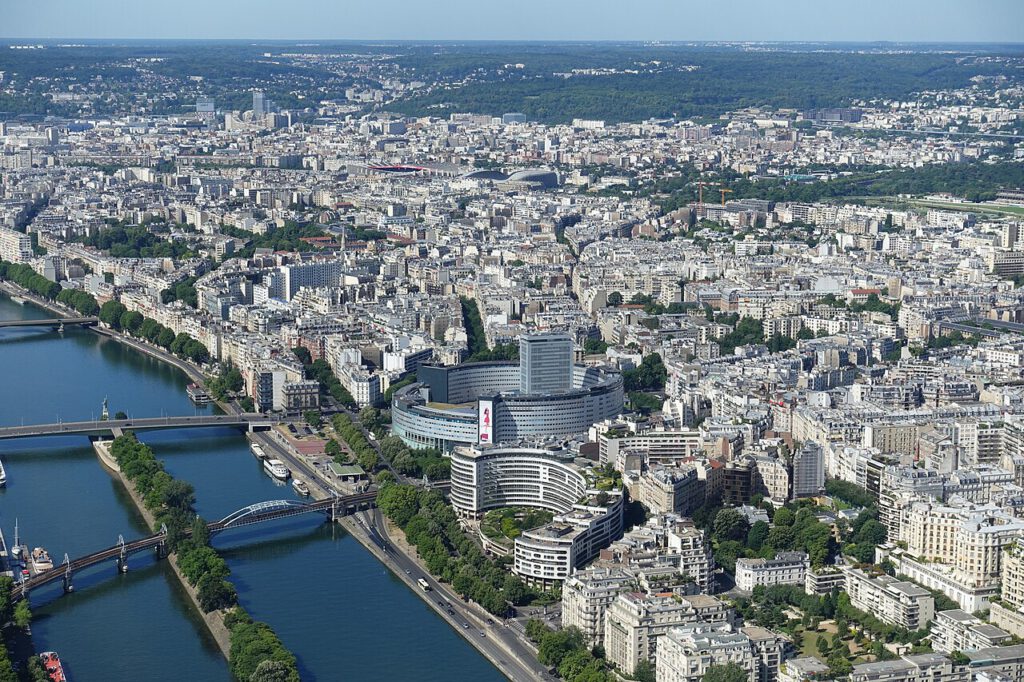
Image courtesy of Guilhem Vellut from Paris, France, CC BY 2.0, via Wikimedia Commons.
The Maison de la Radio (as it was known until 2021, when ‘et de la Musique‘ was appended to its name) has a rich history of organs from its opening in the 1960s. Studio 103, which was subsumed into the new Grand Auditorium, originally housed a relatively modest three-manual 30-stop mechanical-key-action organ by Erwin Müller, inaugurated by Gaston Litaize in 1964. As a result of the 21st-century redevelopment this organ was moved to Église Sainte-Jeanne-d’Arc, Versailles, where it has a new lease of life. Similarly, the larger 101-stop Danion-Gonzalez organ in the larger Studio 104 (Salle Olivier-Messiaen), inaugurated again by Gaston Litaize in 1967, has moved on. This was an iconic instrument, associated with countless broadcasts from leading organists of the day, including Pierre Cochereau and Marie-Claire Alain. The studio remains in use within the reinvigorated Maison scheme, but without an organ – the iconic symbol of France’s neo-classical organ scheme was reworked by Klais, installed in the Cathédrale Notre-Dame de la Treille, Lille, and inaugurated there in 2008.
The new Grand Auditorium, seating 1,400 people, has been designed to offer an immersive experience to concert goers; no seat is more than 17 metres (56 feet) from the stage, and no one has a restricted view. Radio France boasts on its website of ‘exceptional acoustics’, the work of Minoru Nagata, who coincidentally also worked on the new Philharmonie hall! The same site notes a reverberation time of 1.1 to 1.55s – perhaps shorter than ideal for an organ, but certainly encouraging great clarity. The opening bars of Lionel Rogg’s transcription of Maurice Ravel’s Alborada del Gracioso on this album highlights this concert-hall ambience, with a crystal-clear delivery and just enough reverberation to soften the organ’s output. This is an environment which is unforgiving to performers – every detail is heard and there is no room for untidy finger work. Lucile Dollat copes admirably! Ravel’s vibrant ‘Morning Song of the Jester’ introduces us to the whole organ…warm slightly edgy principals; characterful flutes; colourful solo reeds; and a full organ which is forcefully powerful without any hint of harshness. Hearing all of this partnered with Ravel’s quirky rhythms and percussive drive is a delight.
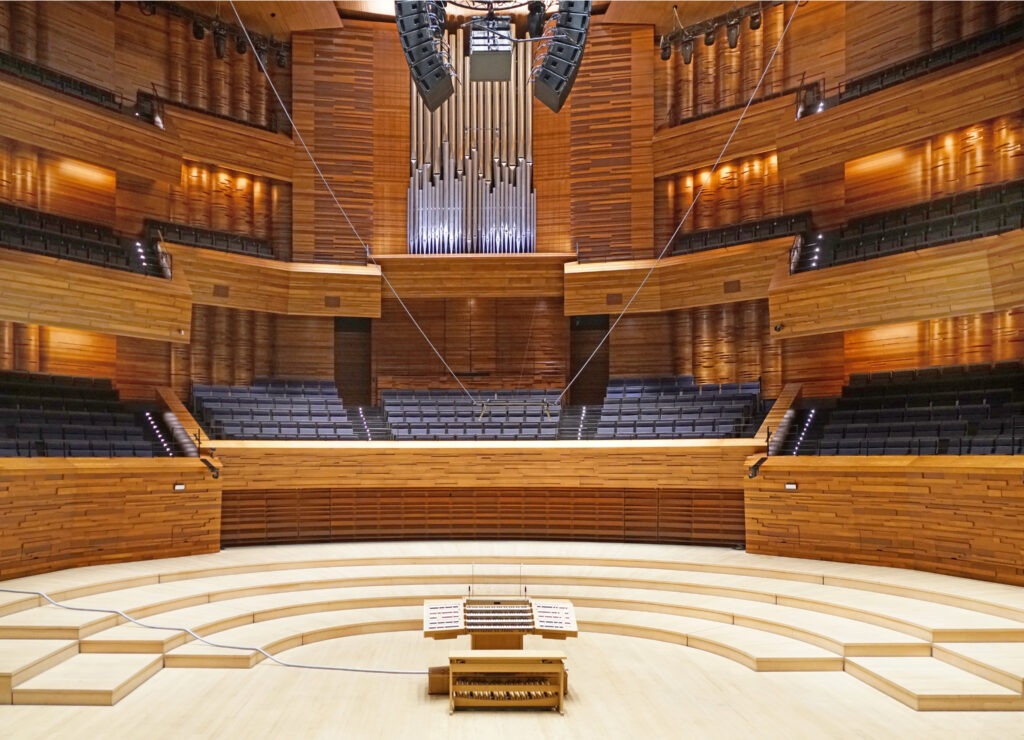
Image courtesy of dalbera, licensed under CC BY 2.0, via Flickr.
The organ is not huge, but well specified – five manual divisions (Grand Orgue, Récit expressif, Positif expressif, Solo expressif with a high-pressure sub-section, and Chamade) boasting numerous unison and sub-unison flues (including three 16′ flues in the Récit), and batteries of mixtures (the Grand Orgue with them neatly separated into Octaves and Quintes). The reed selection is traditional, not adventurous – the usual trumpets and bassoon-oboe registers, and some orchestral colour; capped by both a tuba chorus and chamade ensemble. It’s complete, but certainly not indulgent!
From the Ravel, the programme moves to more adventurous territory, where traditional melody, rhythm and harmonies take a back seat, and the organ moves into the role of soundscape synthesiser. Performer Lucile Dollat contributes three improvised Songes – ‘dreams’ in a literary or poetic guise. I’ve noted elsewhere on aeolodicon that I’m not a fan of recorded improvisation, but I do find these three rather appealing. They benefit from relative brevity (four to six minutes each), and are coherent, honest artistic statements rather than pastiche or stylistic smorgasbord. They also fit well with the written compositions around which they are dispersed. Dollat really tests the expressive capabilities of the organ, with lovely moments of seamless crossfades between different ensembles – there are intriguing moments, complemented by the recording subtly catching the organ’s spatial distribution left to right.
Thomas Lacôte’s La nuit sera calme (‘The night will be calm’) for organ and a rich battery of percussion follows. This was commissioned by Radio France and premiered on the Grenzing organ in 2019. The title comes from the concluding words of a book (with the same title) by Romain Gary, a phrase which Lacôte himself describes as ‘a strange prophecy’. In his commentary to the score, the composer makes clear that he doesn’t want the organ and percussion to stand apart but rather aims for them to meld together. His expectation is that these two sound worlds ‘merge, mask each other, shine through each other, exchange their resonances and transform each other.’
It is interesting that despite the hall’s acoustic clarity, Lacôte has passed the organ (in his own words) ‘through a filter that deprives it of its clearest sonorities.’ His goal is fluidity and continuity, and it is testament to composer and performers that it is achieved so successfully. It’s an eerie work…Lacôte notes a ‘funereal echo’ and ‘diffuse anguish’, so despite the title, this is certainly not a tranquil impression of night and moonlight that we may be used to through Debussy, Vierne or Karg-Elert. I do enjoy this type of music but I find it unmemorable – thought-provoking certainly, and often quite moving, but the lack of melody and traditional harmony makes it difficult to latch onto and retain any firm impression.
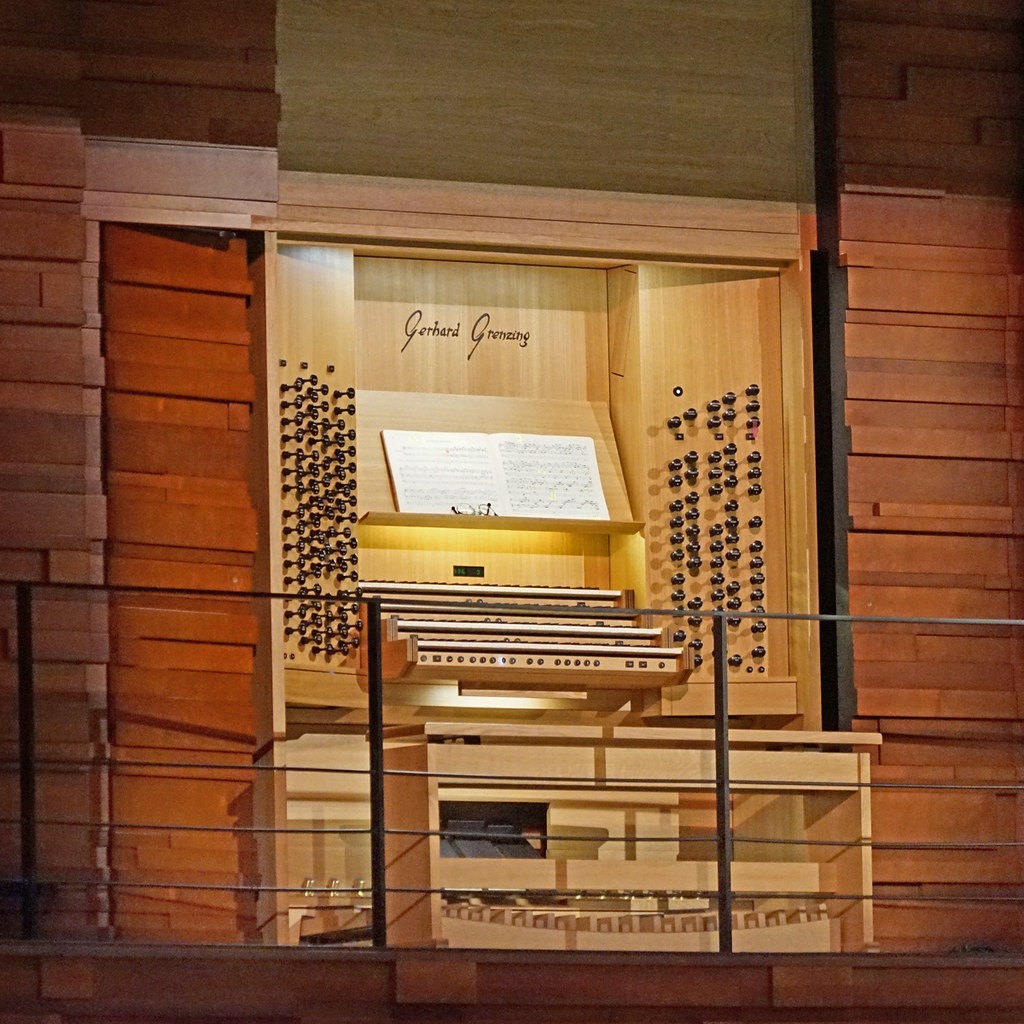
Image courtesy of dalbera, licensed under CC BY 2.0, via Flickr.
The Waksman Night Windows which follow are somewhat more traditional in nature – defined pitch and melody return, but at service to a contemporary musical translation of three abstract expressionist paintings by Richard Pousette-Dart. The music explores themes of vibration, cosmic resonance, and static movement, each movement with its own distinct identity. Hieroglyph, Black is multifaceted with mysterious harmonies, rapidly repeating figurations that dramatically swell and subside through both general (stop) crescendo and swell enclosures, and a quiet close with piquant colours underpinned by software; Genesis, Red is a virtuosic essay, evoking (as the composer comments) ‘the genesis of stars in stellar nebulae.’ Here the organ has a fierce edge to its sound, but this is thrilling to the ears, not painful. The final Radiance, Blue starts with shimmering strings and a long melody, but then builds to an immense and energetic climax. This is exciting music, brilliantly played by Dollat.
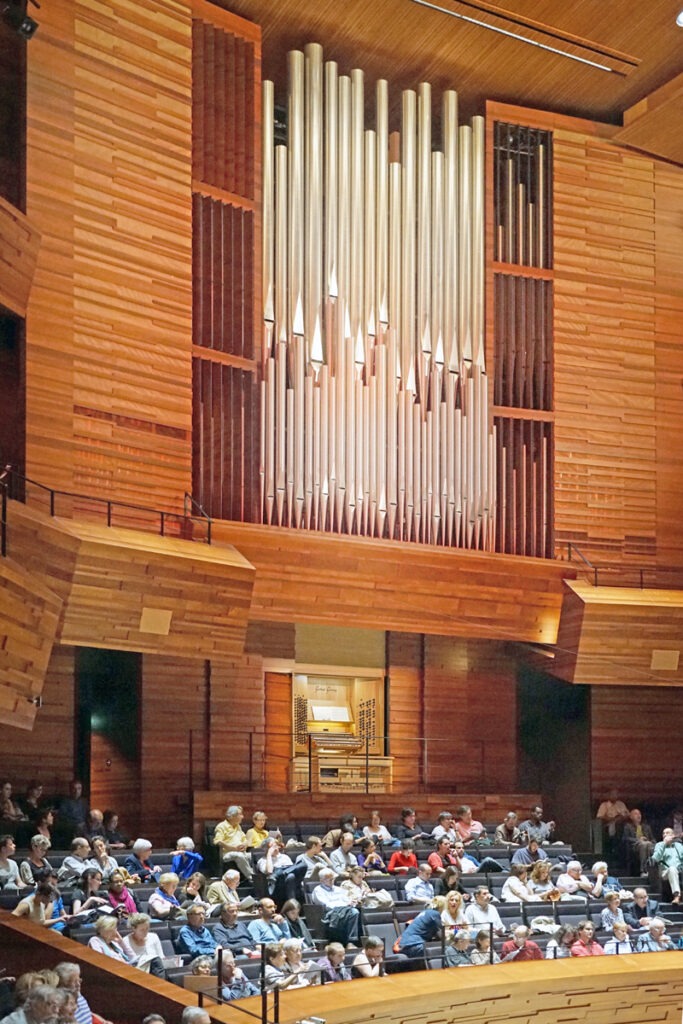
Image courtesy of dalbera, licensed under CC BY 2.0, via Flickr.
The programme concludes with the unique voice of Jehan Alain. The lilting, off-beat Aria was Alain’s final composition – a work that, until this performance, had left little lasting impression on me. Yet, Dollat somehow breathes vivid life into the page. The delicacy of the organ’s quieter ranks perfectly illuminates Alain’s remarkable ear for sonic and harmonic colour. The composer’s best-known work, Litanies, follows, a piece which I’m sure needs no introduction here. What I particular enjoy on this recording is how Dollat and the Grenzing seem to rediscover Alain’s authentic sound world. This music is heard the world over on all and every type of organ; here in the Maison de la Radio et de la Musique the essence of Alain is clear once again.
This recording has grown on me since my first listen. Initially the ultra-clear ambience of the hall and the the transparent, chamber-organ quality of the instrument (despite its size) was disconcerting – but after a while I find it quite refreshing! Lucile Dollat clearly shows in the Lacôte and Waksman how this organ can nonetheless create seamless musical arcs. It is an organ of refined colour, but when pushed it unleashes a raw, fiery full organ which is thrilling.