Album Details
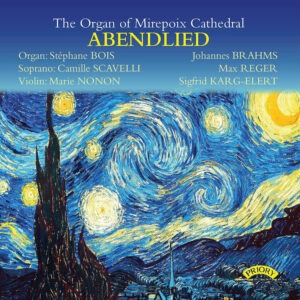
Abendlied
Stéphane Bois (with Camille Scavelli, soprano, and Marie Nonon, violin)
Cathédrale St Maurice, Mirepoix, France
Priory Records (recorded 2018)
Album Contents
Toccata und Fuge, Op.69, Nos. 6 and 7 — Max Reger
Vom Himmel hoch, da komm ich her, Op.78, No.20 — Sigfrid Karg-Elert
Weihnachten, Op.145, No.3 — Max Reger
Sphärenmusik, Op.66, No.2 — Sigfrid Karg-Elert
Vom Himmel hoch, da komm ich her, Op.67, No.42 — Max Reger
Abendstern, Op.98, No.2 — Sigfrid Karg-Elert
Benedictus, Op.59, No.9 — Max Reger
O Welt, ich muß dich lassen, Op.122, No.3 — Johannes Brahms
Symphonischer Choral “Nun ruhen alle Wälder”, Op.87, No.3 — Sigfrid Karg-Elert
O Welt, ich muß dich lassen, Op.122, No.11 — Johannes Brahms
Präludium und Fuge F-dur, Op.85, No.3 — Max Reger
This wonderfully atmospheric recording by Priory Records combines an unusual (and, I’m sure, unknown to many) German organ in a gothic French cathedral with a selection of German romantic works including several rarely heard pieces by Karg-Elert scored for organ, violin and soprano. The music follows the theme of ‘Abendlied’ (evening song), first exploring the chorale Vom himmel hoch, da komm ich her (‘From heaven above to earth I come, To bear good news to every home’) in the spirit of Christmas Eve drawing to a close, and then the evening hymn Nun ruhen alle Wälder (‘Now all the woods are sleeping, And night and stillness creeping, O’er city, man, and beast’).
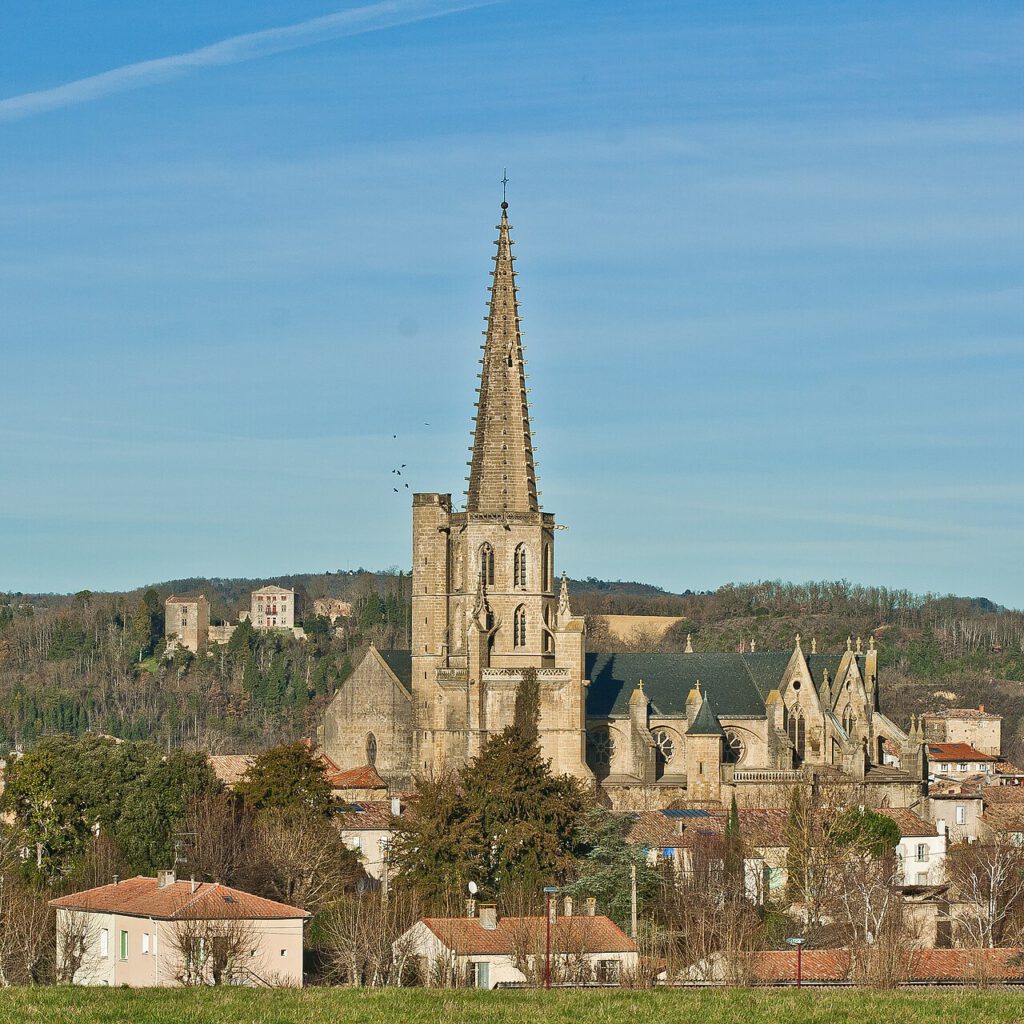
Image courtesy of BastienM, CC BY-SA 3.0, via Wikimedia Commons.
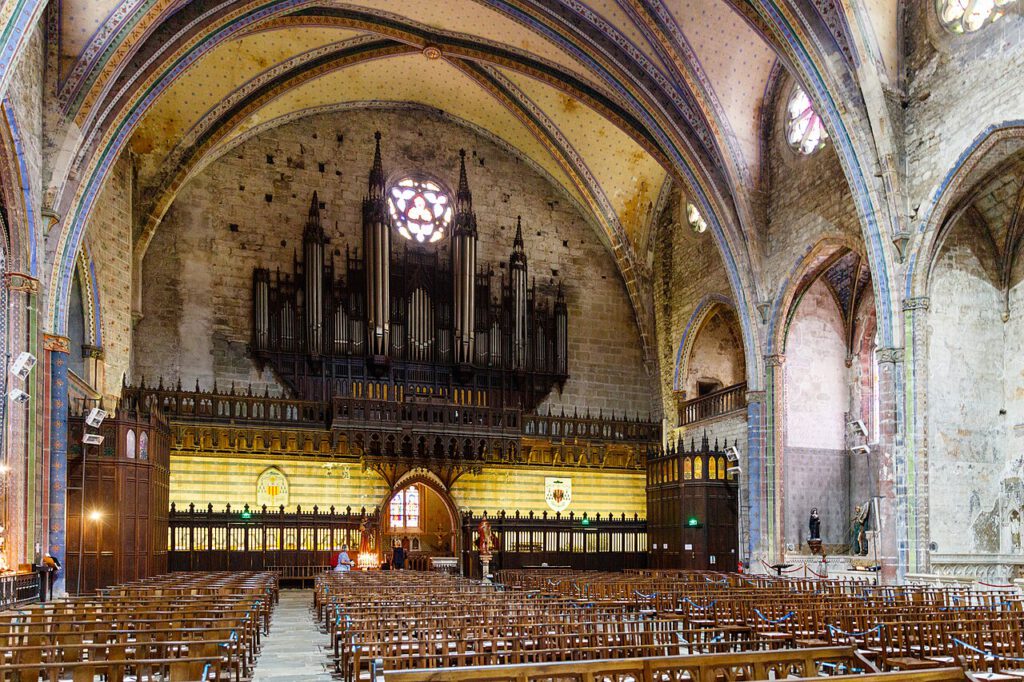
Mirepoix, in the south-west of France, lies between Toulouse, Perpignan and the Spanish border. A small commune of just a few thousand residents, it boasts significant history with a 13th-century layout and a spacious cathedral whose foundations date from the same time. It is said to have the second-widest gothic arch and single nave in Europe (Spain’s Catedrale de Girona takes the title!). For organ lovers, the point of interest is Gebrüder Link’s 1891 Op.171 instrument – a rare romantic German organ in France. In 1882 Canon Gaston bought a redundant Puget organ with the intention of installing it on the south side of the cathedral; plans evolved to seek a new instrument from Puget, but difficulties (unexplained in whatever text I read) led to this being abandoned. Following the death of Gaston, the new Canon Barbe started discussions with the Link firm, and the three-manual, 40-stop instrument is what we hear on this recording – unchanged since its installation.
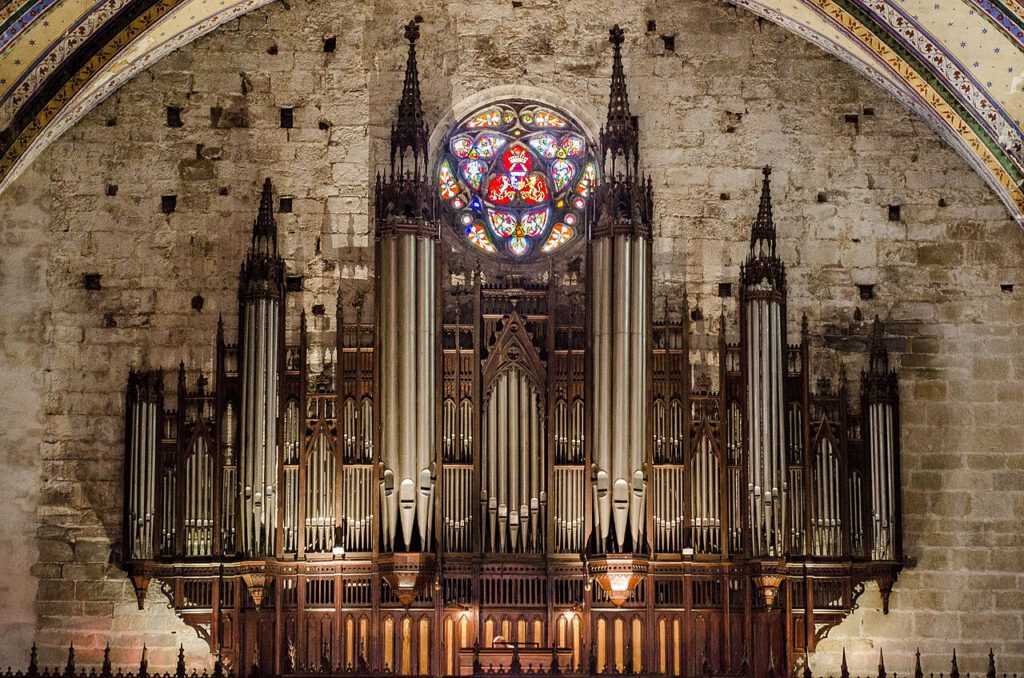
Image courtesy of BastienM, CC BY-SA 3.0, via Wikimedia Commons.
The gothic-style casework was designed by Barbe; it is almost absurdly broad (perhaps an attempt to make its presence felt in the cathedral’s super-wide nave) and highly decorative – spires and lanterns aplenty. The width is deceptive; actually the organ sits within a central niche that covers perhaps half of the visible case width, and the edge portions of the case are impossibly shallow, with front pipes sitting right against the wall! This, together with the fussy pipework, creates an overall effect that feels a little awkward, but this does depend on the lighting – if the back wall is too clearly visible the ‘deception’ seems particularly obvious. Less may well have been more in this case.
Whatever the visual impact, the audio impression of this relatively small organ is spectacular. The French-language specification reflects its location, but the sound is German through and through. Slotted flues afford tight blend and an edge which maintains clarity within the spacious acoustic, whilst the reeds speak more with solid colour than incinerating French finish. The effect is ideal for the gravity and dense harmonies that fuel the music heard on this album.
It opens with Reger’s Toccata and Fugue from his Zehn Stücke, Op.69, classic ‘small’ Reger – the two are consecutive individual pieces in the collection, but perfectly fit together as a pair. The Toccata‘s opening pedal solo highlights Reger’s love of traditional form evidenced throughout his œuvre; from there it develops with increasingly animated figurations, briefly relaxing before a signature conclusion which is chromatically rich and massively dense. The Fuge bursts forth in the same bright D major as the Toccata, and retains its vivace e brilliante spirit throughout. There are some quieter moments, but it comes to a matter-of-fact fortissimo conclusion. As the sound rolls around and fades within the Mirepoix acoustic, this opening makes clear this is a rather special recording!
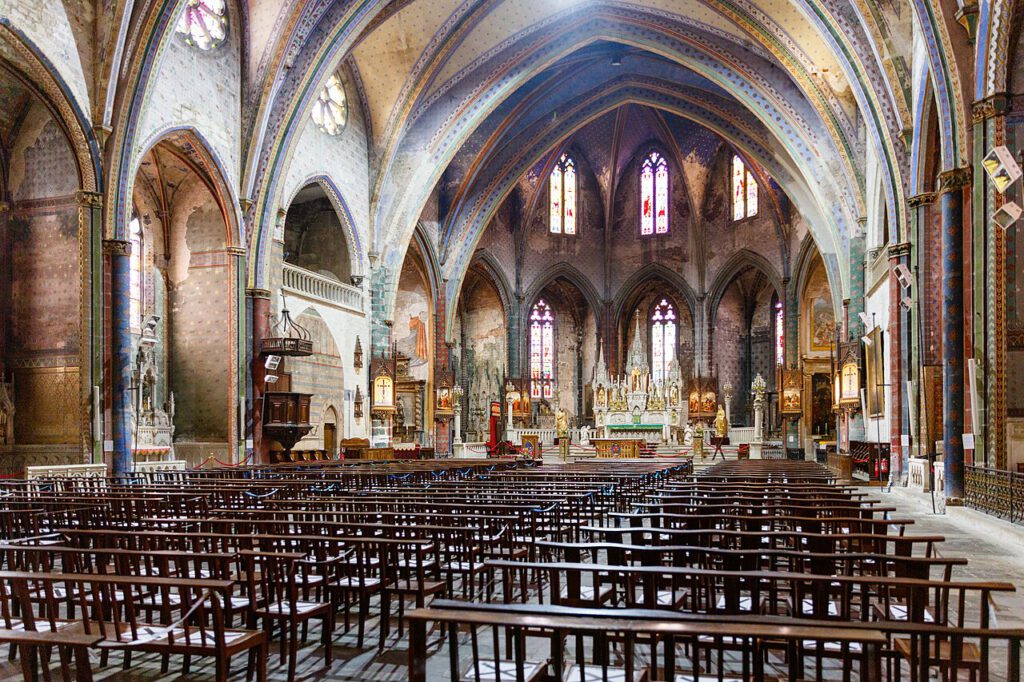
Image courtesy of Marmontel, CC BY 2.0, via Wikimedia Commons.
Now begins the Vom himmel hoch section, with Karg-Elert’s luminous harmonies lighting up the night sky – from the quiet organ registers a free violin melody emerges, weaving up and down; and the soprano takes the chorale melody, voicing the first verse. Between each sung line, organ and violin reflect on the theme – in the last few bars, the first notes of the theme are heard quietly on the organ, whilst the violin climbs up to the highest register for a gently shimmering conclusion. This work (and all the others with violin and voice) is not simply an organ accompaniment for singer with obligato violin – all three ‘instruments’ are equal partners, each contributing uniquely to the overall effect.
This recording wisely intersperses music by Reger and Karg-Elert; too much of either, as wonderful they are, can play havoc with the musical digestion! Reger’s Wiehnachten (from his monumental last published organ work, Sieben Stücke, Op.145) nicely balances Karg-Elert’s richly lyrical impressionism, although this is Reger at his most poetic. ‘Christmas’ is the title, and it weaves together four relevant chorales covering both Advent and Christmas. After a grand climax (this is Reger, after all!) tension subsides in the lowest octaves before Vom himmel hoch emerges in the highest registers with the Positif Clarinette at the same time intoning Stille Nacht (Silent Night) in the tenor.
Karg-Elert’s Sphärenmusik is subtitled Weihnacht Gedicht (a Christmas Poem), setting a short poem by Frieda Schanz (1885-1944) which starts ‘High from heaven the angel sang’. As with those opening words, so the music draws upon the spirit of Vom himmel hoch, Karg-Elert once again injecting his unique harmonies and delicately coloured organ registrations into this sublime setting for voice, violin and organ. This section of the programme draws to a close with the drama and bluster of Reger’s short Vom himmel hoch (from his Op.67 collection of “easy” chorale arrangements) – the grandeur surely reflects the final verse: ‘Glory to God in highest heaven, Who unto man His Son hath given!’
Abendstern for voice and organ is again not a simple song with organ accompaniment, but a truly symphonic duet – two equal partners musically exploring the wonder of the evening star, “silent splendour, quiet splendour, diamond jewellery of the night.” Who better to transform such impressions into music than Sigfrid Karg-Elert, a true master of impressionism, harmony and colour? After such excesses, we are grounded (just) with Reger’s popular Benedictus, once again exploring the full capabilities of the Mirepoix organ.
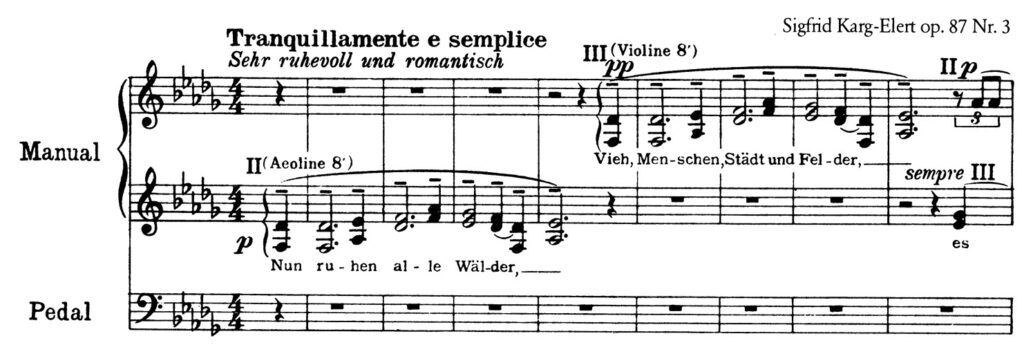
Reproduced from IMSLP open-access score.
Nun ruhen alle Wälder, the second thematic strand of the recital is now introduced through works by Karg-Elert and Brahms. It’s clever programming by Stéphane Bois – strictly this Lutheran chorale is only heard in Karg-Elert’s substantial symphonic chorale (the third of his Op.87 set), but the melody is shared with the chorale O welt, ich muß dich lassen, heard in two settings by Brahms. This is a lovely touch, because Karg-Elert himself quotes Brahms in the symphonic chorale, with motives from his Wiegenlied, (the lullaby or cradlesong in the Op.49 five songs) present at the start and the end. The symphonic charle is the longest piece on the album (just under 16 minutes) and its a gorgeously expansive setting for organ, violin and voice. As before, the three are treated as equal partners, and the melody (heard complete several times) is shared between them all. At times it is sung, with a lyrical countermelody on the violin, and rich accompaniment on the organ; at others, the violin takes the melodic theme with the words assigned to a weaving countermelody. In the final verse, the melody is assigned to both the violin (in ‘short’ crotchets) and organ (in ‘long’ minims), with the soprano again acting as a countermelody. The work subsides to a tranquil close, quoting again Brahms’ Wiegenlied – Karg-Elert references specific lines of the lullaby in his foreword to the published score: first ‘Tomorrow morning, if God wills, You will wake once again’, and then ‘Sleep now blissfully and sweetly, See paradise in your dreams.’
After Brahms’ staid chorales and the harmonic excesses of Karg-Elert, the last word is given to Reger, with his little-heard third Präludium und Fuge from his Op.85 set. The prelude is quietly lyrical, unusually modest in its effect. The fugue follows the typical Reger pattern of starting quietly and building, inexorably to ‘Org Pl’, a full organ grandly voiced on the Mirepoix Link.
A perfect example of the pastel shades that serried ranks of quiet flues allow in these German romantic organs
I opened this article with the comment ‘wonderfully atmospheric’ – the music contributes to this, but so too does Priory’s spacious recording. This is certainly no ‘studio’ recording with crisp portrayals of pipes, strings and voice, and its all the better for this. The three are warmly and cohesively enveloped in the cathedral’s generous acoustic. Admittedly the words of the vocal part are not easy to distinguish (even with the words printed in the liner notes) but for me that doesn’t matter – it sounds exactly as I’d expect it to sound with (as I imagine it) three musicians making music together around the console in the organ loft, captured from a distance by Priory’s trademark single microphone placement. Combinations like this do draw attention to the fluid expression of strings and voice in contrast to the relative inflexibility of the organ – its a testament to both builder and performer that the contrast is so mild. There are wonderful moments where a single organ flute tonally transforms through its compass, gently ‘shining’ in the upper registers. The strings, with a keen edge, are still beautifully musical, and the back and forth between the pianissimo ensembles at the start and close of Karg-Elert’s Nun ruhen alle Wälder (and indeed in many other parts of the programme) are glorious – a perfect example of the pastel shades that serried ranks of quiet flues allow in these German romantic organs. When the violin first appears, it is initially impossible to distinguish it from the organ tone that supports it, and then it soars upwards making itself known – a truly beautiful moment, and just one of many which are present on this recording.
I’ve mentioned in other posts how ‘noises off’ can add some magical realism to recordings of organs; often its key action clattering away, sometimes the thump of stops moving in or out at the touch of a piston, or even the slow creak of a swell mechanism. At Mirepoix the action noise is prominent; I’m sure some will find it a great distraction but for me it helps paint a full and rich picture of this wonderful organ.
All three musicians give fine, musically sensitive performances – particular note must be made of organist Stéphane Bois, whose hands and feet are in action for every track of the album. At the time of writing he is titulaire of this Link organ in Mirepoix, having previously spent a decade (from 2004) as co-titulaire at Toulouse’s Cathédrale Saint-Étienne. He adroitly handles the many demands made upon him by Reger and Karg-Elert in their challenging compositions, handfuls of notes complemented by sensitive musicianship and nuanced registrations.
This is a magical album, where brilliant performers, colourful organ and a recording that perfectly captures the moment unite in an exquisite programme of less-commonly heard celestial reflections. Perfect!