
Album Details
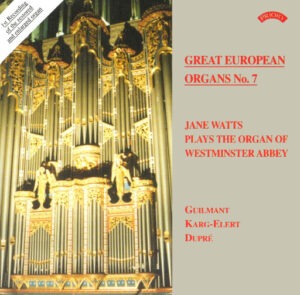
Great European Organs No.7
Jane Watts
Westminster Abbey, London, UK
Priory Records (recorded 1988)
Album Contents
Sonata No.1, Op.42 — Alexandre Guilmant
Marche Religieuse, Op.15, No.2 — Alexandre Guilmant
Passacaglia and Fugue on BACH, Op.150 — Sigfrid Karg-Elert
Cortège et Litanie, Op.19a — Marcel Dupré
Variations sur un Noël, Op.20 — Marcel Dupré
Sept Pièces, Op.27 – 7. Final — Marcel Dupré
This recording was released by Priory in my very early days of collecting CDs. I remember the glowing review in The Gramophone (“I cannot remember when I last enjoyed organ playing, either recorded or live as much”) and the exciting anticipation of my first listen. The first seconds are certainly attention grabbing, with the powerful chordal entry of Guilmant’s first Sonata capped by the (at that time, brand new) Bombarde reeds. To my young ears, it sounded so French, but of course it isn’t – the mixtures are controlled and in tune (!), the reeds are politely solid…but those Bombarde trumpets add a fizzy je ne sais quoi, and there is sufficient upperwork to add some edge to proceedings.
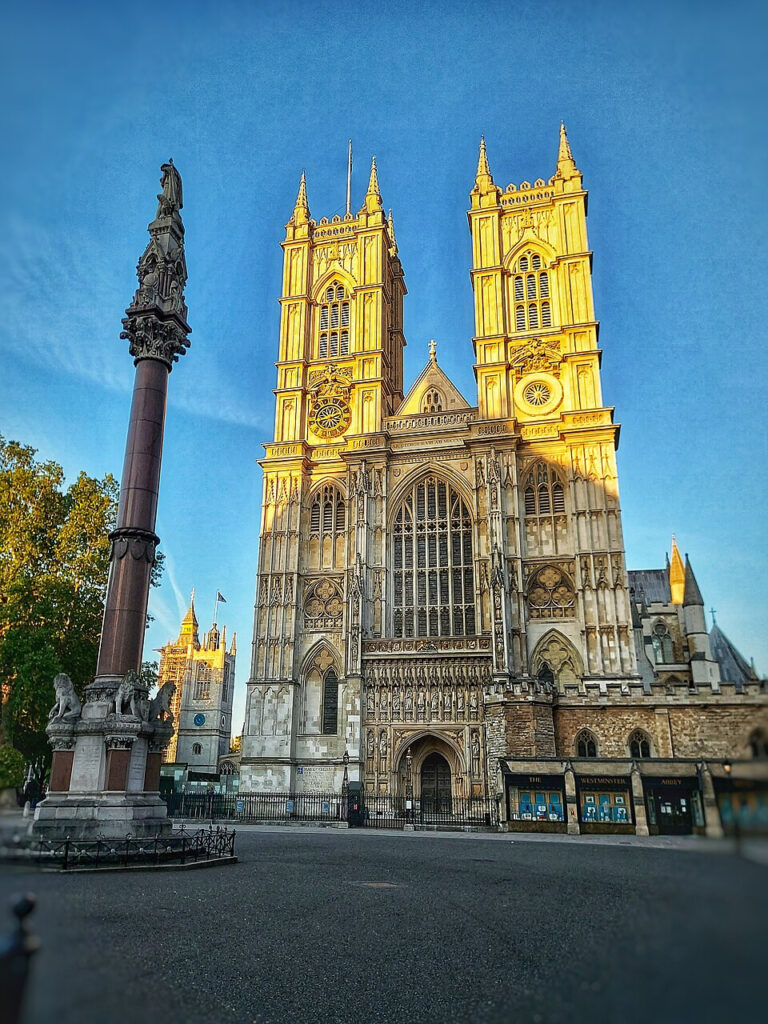
Image courtesy of Bartolo Creations, CC BY-SA 2.0, via Wikimedia Commons
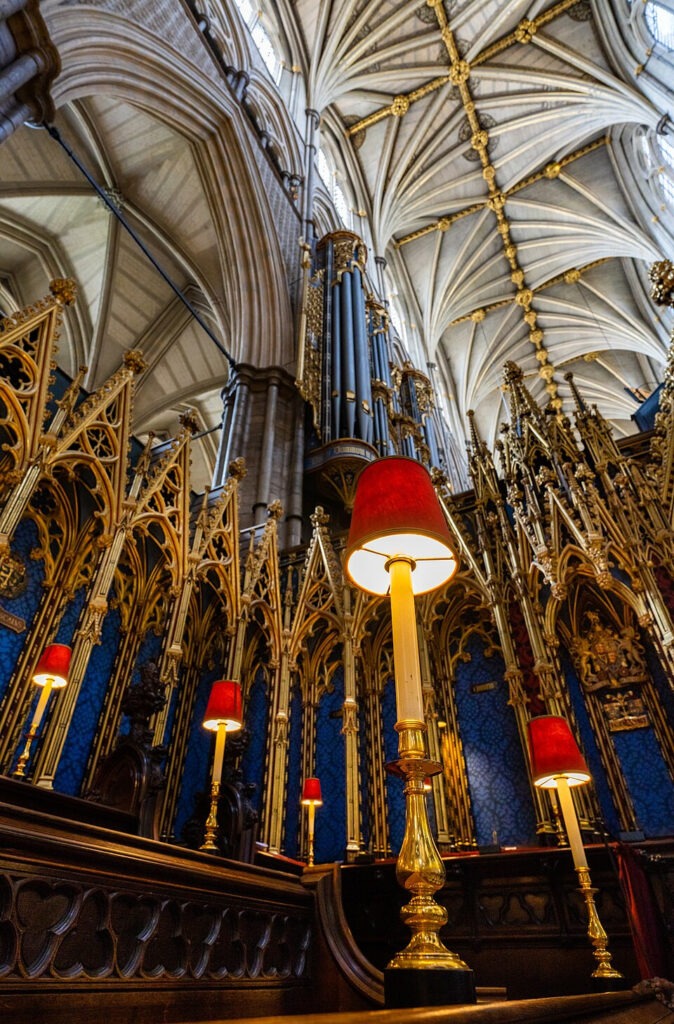
The recordings that got me hooked on the organ were on this same organ – the two legendary discs of Simon Preston (on Deutsche Grammophon) playing Reubke/Liszt and Widor/Vierne. I say the same organ, but Preston’s recordings were made in 1983 and 1984 when five years’ of work started by Harrisons in 1982 were underway but by no means completed. Certainly the Bombarde division, in the triforium with chorus above the main case and celebratory reeds one bay to the west, wasn’t in place for the DG recording sessions, but otherwise I don’t know how different the specifications were.
The Guilmant Sonata is exhilerating, the massive Introduction et Allegro countered by the toccata-like Final with its scintillating moto perpetuo figurations. Sandwiched between these two heavy weights is the tranquil 12/8 Pastorale, flutes and strings to the fore, juxtaposed with a glorious chorale on the Voix humaine underpinned by that oh-so-English effect, the gentle rumble of a 32′ double open. The Marche Religieuse (on Handel’s “Lift up your heads”) begins in sombre mood (Allegro moderato e maestoso) but picks up at the spirited fugal Piu mosso, soon weaving in the opening march theme. It concludes grandly Maestoso with pedal work doubled at the octave.
The Karg-Elert is absolutely thrilling, and certainly a reference recording by which all others should be judged
It is clear that Jane Watts is on brilliant form for this early Great European Organs release; I believe its her first recording on CD, preceded only by a 1984 LP of music by Buxtehude, Dupré, Guilmant, Mathias, Mendelssohn and Mozart on the recently completed Collins organ in St David’s Hall, Cardiff. In 1986 she was the inaugural Royal College of Organists ‘Performer of the Year’ which accelerated her career with prestigious engagements across the UK. But even at this young age (she was just 26 when she won) she already had numerous prizes from both the Royal College of Music and the Royal College of Organists. She studied with Marie-Claire Alain in Paris, and was the first organ scholar appointed at Westminster Abbey, working with Simon Preston. This, her debut CD, being made on the Westminster organ seems, therefore, quite fitting.
Maksim Sokolov (maxergon.com), CC BY-SA 4.0, via Wikimedia Commons
After the Parisian opening of her recital, Jane Watts changes direction with Sigfrid Karg-Elert’s monumental Passacaglia and Fugue on BACH, Op.150. His last-written organ work, this is a substantial creation, typically clocking in with a 20-minute or longer duration – Watts delivers it in a sprightly 18′ 34″. Typically for Karg-Elert it is virtuosic and highly colourful, allowing the full resources and dynamic range of the Abbey organ to be explored. This is one of the few recordings where the dynamic range is almost too large…if you really want to hear the single string register in the Adagio (quasi echo) you do threaten a technology (and physiological) melt-down in the ensuing Più mosso when the Bombarde reeds (yet again) erupt! All in all, it is absolutely thrilling, and certainly a reference recording by which all others should be judged.
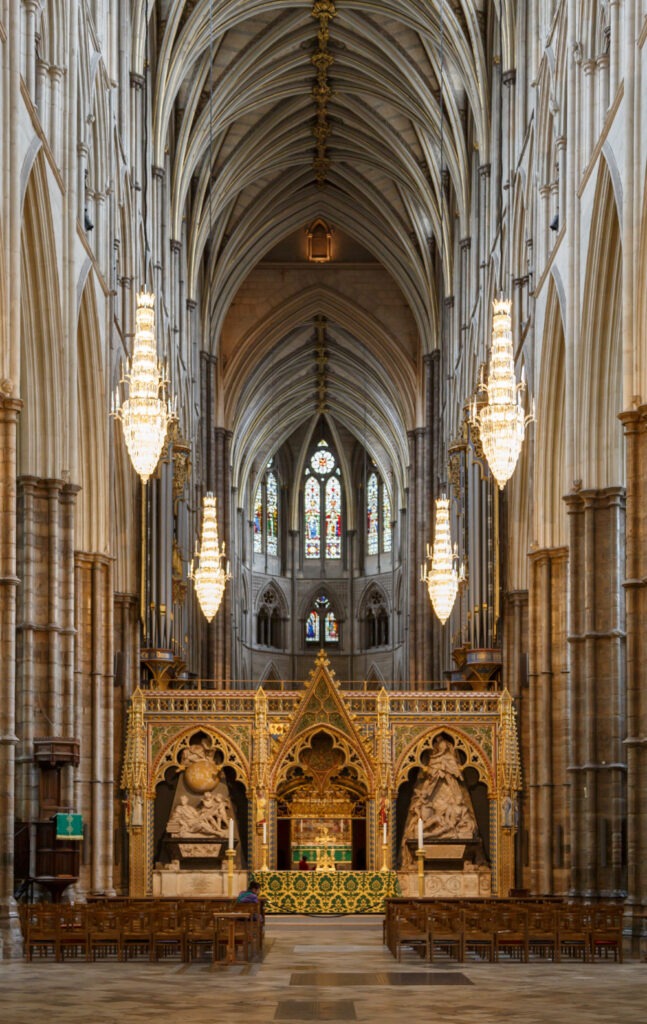
Photo by CEphoto, Uwe Aranas, CC BY-SA 3.0, via Wikimedia Commons
From Germany, the programme returns to France for its conclusion, with something a little more modern by way of Dupré’s Cortège et Litainie, Variations sur un Noël, and the Final from the Op.27 seven pieces. Jane Watts delivers again, with technically precise, impassioned performances – the coruscating figurations at the end of the Variations which then transform into determined chimes are perfectly paced. The energetic Final which follows feels almost redundant, but certainly leaves no doubt that the end of a spectacular recital has been reached.
The recording by Priory Records sounds very natural; the lower notes of the Harrison pedal Ophicleide ‘foghorns’ add real fundament, complemented by a guttural roar; some divisions sound just a little distant (which they would, wouldn’t they?); and the Abbey’s modest 2-3 second reverberation is warmly experienced. Priory’s strap line has always been that they aim to record from the best seat in the house, which I suppose is a little subjective – one person’s natural ambience is another’s muddy confusion. For me, though, this is the best result I’ve heard from the Abbey.
Overall, there’s nothing to fault this recording. Granted, some may prefer their Guilmant, Dupré and Karg-Elert on stylistically better suited instruments (Cavaillé-Coll, Steinmeyer, Walcker etc) but none of these composers wrote and performed in geographic isolation. They were international musicians, writing for performance on a wide variety of instruments across the world. Westminster Abbey’s Harrison and Harrison organ may not be the first choice for this programme, but with Jane Watts’ career-defining performance captured by Priory’s well-placed microphones, it is hard to fault.
